Bootcamp
Module 11 — Backend workflows: automation, recursion and scale

Photo by Josefina Di Battista on Unsplash
Everything to this point ran while a user watched. Module 11 crossed the line into software that works while everyone sleeps — and into the failure modes that only exist on the other side of that line.
Backend logic is application behaviour that belongs to the system, not to a screen: nightly jobs, reactions to data changes, thousand-record updates. The moment your product needs any of these, you’ve graduated from building pages to operating software.
The curriculum
A recap of workflow concepts bridged from Module 7, then the toolkit: API workflows (server-side logic as callable units), recurring events for schedules, database triggers for change-reactions — with the warning every senior dev eventually earns about triggers cascading into triggers. Then bulk processing as a genuine engineering choice: on-a-list actions, recursive workflows (the professional’s pattern — process one, schedule the next), a process data type for tracking long-running jobs, bulk actions, and the Data API. The module closed with the grown-up trio: keeping workflows organised, debugging things you can’t see (server logs as your eyes), workload-unit considerations — compute costs money, inefficiency is a bill — and race conditions.
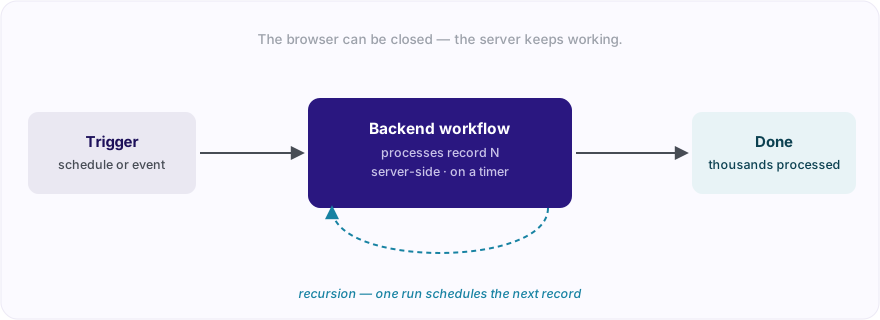 The recursive-workflow pattern the module turns on: a trigger starts a server-side run that processes one record and schedules itself for the next — so a job over thousands of records runs on the server, on a timer, with the browser closed.
Try it yourself
Find the automation hiding in your app — the thing someone does manually every week. Design it as a backend job on paper: trigger (schedule? data change?), the per-item steps, what marks an item done (so a re-run doesn’t double-process), and what the log line says. That last question — how will I know what happened? — is the one that separates hobby automation from production automation.
This skill in the AI era
Queues, idempotency, retries, race conditions: this is distributed-systems thinking with the jargon removed, and it transfers to serverless functions and scheduled jobs without translation. When Claude Code writes our background jobs, the review questions come straight from Module 11 — what happens on re-run, on overlap, on failure halfway? Builders who ask those questions ship automation that holds; builders who don’t, ship time bombs. More on the transition.
If this sparked something, let's talk.
No pitch, no pressure — just a conversation about what you're working on.
Let's talkRelated posts
AI Implementation
Build Your AI BI Analyst: The Report That Builds Itself
Most business intelligence work in a small or mid-sized company is assembling the same pack every week and answering the same questions slightly differently. AI can carry 50 to 80 percent of it. Here's how we build an AI analyst, and the rule that stops cheap numbers causing chaos.
Bootcamp
A simple approach to data modelling
A four-step method for designing a database schema: identify entities, map relationships, choose fields. Taught through the CRM data model built in Bubble.
Bootcamp
API calls as actions vs data (and the planning checklist)
When to use Bubble API calls as actions versus data sources, a one-to-many auth pattern, and the planning checklist that keeps integrations from failing silently.