AI Strategy
When Your Software Vendor Sells You AI: A Four-Question Test
Every established software vendor is arriving at the same conference slide this year: AI, embedded in the product, available soon on a new tier. If you run a business on an ERP, a CRM, an accounting package and a handful of specialist tools, you will be offered AI several times over in the next twelve months. Before you sign, it is worth...
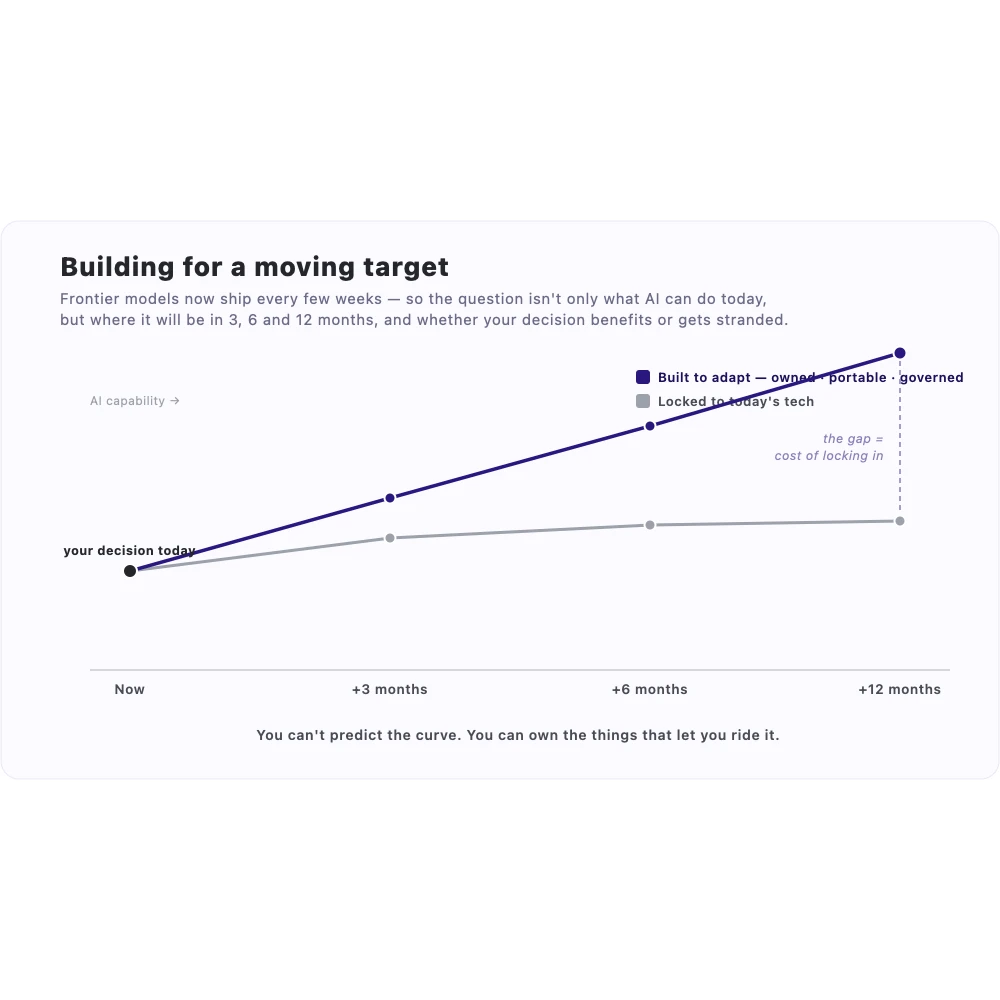
Every established software vendor is arriving at the same conference slide this year: AI, embedded in the product, available soon on a new tier. If you run a business on an ERP, a CRM, an accounting package and a handful of specialist tools, you will be offered AI several times over in the next twelve months. Before you sign, it is worth understanding why the offers are coming, and having a test ready. The per-seat subscription model was built on the cost of building software. That cost has collapsed. Small teams with AI coding tools now ship in weeks what once occupied a vendor's roadmap for a year, and an ordinary assistant subscription covers much of what specialist features used to bill for separately. Vendors know this. Their response is to embed AI, price it as a tier, and keep customers inside the product. It is a rational response to a business model under threat, and it is not in their interest to explain that context to you. The vendors still own something valuable: they are...
AI Strategy
Inverting the Approval Pyramid: A Governance Model for Bottom-Up AI
We wrote recently that AI isn't the bottleneck, leadership attention is. That piece was a diagnosis. This one is the treatment we recommend. The short version: most organisations still run an...
We wrote recently that AI isn't the bottleneck, leadership attention is. That piece was a diagnosis. This one is the treatment we recommend. The short version: most organisations still run an approval model built for a world in which trying something was expensive. It no longer is. The model needs turning over. | | Traditional model | ||| | Who may start something new | Whoever secures executive sponsorship | | What travels up | Proposals and requests for permission | | What travels down | Approval and budget | | Capacity limit | The number of decisions a few senior people can make | | What happens to good ideas at the edge | They wait, shrink, or leave with the person who had them | Middle managers sometimes create pockets of initiative, and those pockets tend to close when the manager moves on or a new corporate programme arrives. Nothing in the structure holds them open. Two things change at once. Attempts become cheap. A staff member with a company AI seat can build a working...
AI Implementation
Build Your AI Executive Assistant: What It Does, What It Never Does
Most founders and senior people we meet do not have an executive assistant. They have an inbox, and the inbox is winning. It is not only the hours. Each email asks for a judgement call, a few are...
Most founders and senior people we meet do not have an executive assistant. They have an inbox, and the inbox is winning. It is not only the hours. Each email asks for a judgement call, a few are unwelcome, and an overloaded leader spends the sharpest part of the day sorting instead of thinking. The work that matters waits behind the work that arrived. We run our own group of businesses on an AI executive assistant, and we build the same thing for clients. Here is what we have learned. Look at what an executive assistant does in a week and sort it into two piles. Repetitive: reading everything, working out what needs the boss and what does not, drafting the predictable replies, keeping the calendar accurate, chasing the people who have not answered, filing, and producing a summary of where things stand. Judgement: knowing this client needs a call rather than an email, protecting time, reading the room. The first pile is most of the hours, and it is exactly what a well-built AI does...
AI Strategy
Did AI Just Kill BI? What to Stop Paying For, and Where to Spend Instead
Our founder spent four years as a BI solutions architect in a large public health system before starting Momentum. His summary of that era is blunt: the discipline was called business intelligence, and the budget went on plumbing. That is not a criticism of the people. It was the economics. And those economics have just changed, which means most...
Our founder spent four years as a BI solutions architect in a large public health system before starting Momentum. His summary of that era is blunt: the discipline was called business intelligence, and the budget went on plumbing. That is not a criticism of the people. It was the economics. And those economics have just changed, which means most organisations are about to fund the wrong things out of habit. Any honest breakdown of a BI programme looks something like this. | Activity | Share of effort, traditionally | What it involves | |||| | Integration | The clear majority | Locating data, gaining access, cleaning it, matching records across systems, building and operating ETL, modelling a warehouse | | Presentation | A meaningful slice | Dashboards, report layouts, licences for the tool that displays them | | Governance | Whatever was left | Definitions, ownership, quality rules, access policy, lineage | | Analysis | Friday afternoons | Interpreting results, testing explanations,...
Marketing
llms.txt, robots.txt and What AI Actually Reads on Your Website
Every website has two audiences now: people, and the machines that read on their behalf. When a prospect asks ChatGPT or Claude to recommend a provider in your category, the answer is assembled from...
Every website has two audiences now: people, and the machines that read on their behalf. When a prospect asks ChatGPT or Claude to recommend a provider in your category, the answer is assembled from what those systems were able to read. Generative engine optimisation (GEO, sometimes called LLMO) starts with a dull question. Can they read your site at all? Two small text files sit at the centre of that question, and they do very different jobs. has been around since the 1990s. It lives at the root of your domain and tells automated visitors what they may and may not fetch. Reputable AI companies honour it. What has changed is the list of visitors. These are the ones worth knowing. | User agent | Operator | What it is for | |||| | | OpenAI | Collecting content to train models | | | OpenAI | Indexing for ChatGPT's search results | | | OpenAI | Fetching a page because a user asked about it | | | Anthropic | Collecting content to train models | | | Anthropic | Indexing for search | |...
AI Implementation
Build Your AI Middle Manager: Tracking, Chasing and Reporting on Autopilot
In a business of five to thirty people there is rarely a management layer. There is a founder, a few senior people, and a shared hope that everyone remembers what they said they would do....
In a business of five to thirty people there is rarely a management layer. There is a founder, a few senior people, and a shared hope that everyone remembers what they said they would do. Coordination happens in a Monday meeting and then decays through the week. This is the gap an AI manager fills. Not leadership. The administrative spine of management that small teams go without. | When | What the AI manager does | Who acts | |||| | Each morning | Posts a short status per person: due today, overdue, blocked | Each team member | | Mid-week | Notices work with no movement and asks the owner, privately, what is in the way | Task owner | | As needed | Suggests a smaller next action for anything stalled | Task owner | | Thursday | Drafts nudges for outstanding client or supplier inputs | A person approves and sends | | Friday | Summarises for leadership: delivered, late, at risk, decisions required | Founder or lead | | Month end | Runs the recurring process checks: reconciliations done,...
AI Implementation
The AI-Native Stack for a Small Business or Not-for-Profit
New organisations tend to assemble their technology the same way: one subscription per problem. A site builder for the website, an email platform for the newsletter, a scheduler for social posts, a form tool, a CRM. Within a year there are eight logins, eight invoices and eight places where a fragment of the truth lives. It works, until you try to...
New organisations tend to assemble their technology the same way: one subscription per problem. A site builder for the website, an email platform for the newsletter, a scheduler for social posts, a form tool, a CRM. Within a year there are eight logins, eight invoices and eight places where a fragment of the truth lives. It works, until you try to use AI across it. An assistant cannot answer "who attended in March and has not heard from us since?" when attendance is in one product, contacts in a second and sends in a third. We set up small businesses and not-for-profits differently. Four layers, chosen so that everything the organisation knows is in one place an AI can reach. | Layer | What we use | What it holds | |||| | Home | Google Workspace | Identity, email, calendar, files, sheets, forms, meetings | | Front door | An Astro website on free hosting | Public pages, plus structured collections such as events, chapters, programs and people | | Intelligence | Claude, with the Google...
AI Implementation
Build Your AI CFO: Cash, Chasing and the Monthly Pack Without the Headcount
A business with twenty staff has a bookkeeper, an external accountant and a founder who opens the banking app more often than they would like to admit. What it does not have is a finance lead:...
A business with twenty staff has a bookkeeper, an external accountant and a founder who opens the banking app more often than they would like to admit. What it does not have is a finance lead: someone whose job is to know, this week, how much room there is to move. Hiring that person is out of reach at this size. Building most of that function is not. When we scope a finance build we put every recurring finance task into one of three columns. | Column | Examples | Who does it after the build | |||| | Assemble | Weekly cash summary, aged debtors list, month-end pack, deadline calendar | The AI, on a schedule | | Match and chase | Supplier bills against purchase orders, overdue reminders, missing-receipt requests | The AI prepares, a person approves | | Decide and advise | Pricing, hiring, borrowing, tax position, anything signed | People: owner, bookkeeper, accountant | In most small businesses the first two columns are 50 to 80 percent of the hours. They are also the hours nobody is...
AI Strategy
AI Isn't the Bottleneck. You Are.
Companies are making people redundant and pointing at AI. The story goes: AI is faster, cheaper, and doesn't need a salary. So we need fewer humans. That's not what's actually happening. The real...
Companies are making people redundant and pointing at AI. The story goes: AI is faster, cheaper, and doesn't need a salary. So we need fewer humans. That's not what's actually happening. The real reason people are losing their jobs isn't that AI replaced their work. It's that AI created so much new output that leadership couldn't keep up — and instead of solving that problem, they cut headcount. That's not an AI problem. That's a management problem. Before AI, a typical leadership team might oversee five major initiatives at once. Strategy, resourcing, review cycles, decision points — all manageable within the bandwidth of the people at the top. Now AI can spin up fifty. Fifty projects. Fifty streams of output. Fifty things that need someone to read them, evaluate them, challenge them, and decide whether they're worth pursuing. The AI doesn't care. It'll keep producing. But the humans at the top? They're drowning. And when executives drown, they don't hire more reviewers. They cut the...
AI Implementation
Build Your AI BI Analyst: The Report That Builds Itself
Most organisations under a hundred people sit at one of three reporting levels, and it is worth knowing which one you are on before buying anything. Level one: the spreadsheet ritual. A capable person spends part of every week exporting, pasting and tidying so a meeting can happen. The knowledge of how it works lives in their head. Level two: the...
Most organisations under a hundred people sit at one of three reporting levels, and it is worth knowing which one you are on before buying anything. Level one: the spreadsheet ritual. A capable person spends part of every week exporting, pasting and tidying so a meeting can happen. The knowledge of how it works lives in their head. Level two: the dashboard nobody opens. A BI tool was purchased, a consultant built some charts, and eighteen months later the team still asks the capable person for a spreadsheet. Level three: reporting that arrives, and answers back. The regular report turns up on time without anyone building it, and a follow-up question gets a reply the same hour. An AI analyst is the quickest route from the first level to the third, and it usually skips the second entirely. We estimate 50 to 80 percent of analyst hours at this size go on three activities: Producing the recurring report. Same sources, same layout, every week or month. Re-cutting it on request. By program,...
AI Strategy
AI Security and Governance: A Practical Guide for Business Leaders
AI adoption in business is accelerating. Tools like ChatGPT, Claude, Copilot, and dozens of industry-specific AI platforms are becoming as commonplace as email. And that's broadly a good thing —...
AI adoption in business is accelerating. Tools like ChatGPT, Claude, Copilot, and dozens of industry-specific AI platforms are becoming as commonplace as email. And that's broadly a good thing — businesses using AI effectively are seeing real gains in productivity, quality, and speed. But there's a conversation that's not happening often enough: what are the risks, and how do you manage them? This isn't about fear-mongering. It's about being thoughtful. The businesses that adopt AI responsibly — with proper security and governance — are the ones that will scale AI confidently. The ones that don't will eventually have an incident that makes the entire organisation gun-shy about AI for years. Let's make sure you're in the first group. AI introduces several categories of risk that traditional software doesn't. Understanding them is the first step to managing them. This is the most immediate and most common risk. Every time someone in your organisation pastes information into an AI tool,...
AI Implementation
Build Your AI Coach: Personal, Professional and Productivity Coaching on Tap
Few small businesses can fund coaching for anyone below the leadership team, and many cannot fund it there either. So development becomes something that happens in an annual review and is otherwise...
Few small businesses can fund coaching for anyone below the leadership team, and many cannot fund it there either. So development becomes something that happens in an annual review and is otherwise left to chance. An AI coach changes the economics. We think 50 to 80 percent of what a coaching relationship delivers is structure: a regular prompt to reflect, continuity between sessions, and a safe place to practise. That structure can be given to every person in the business for the cost of a seat they already have. Preparing for one-to-ones. Before the meeting, each person spends five minutes answering: what moved, what is stuck, what do I need from my manager? The meeting starts at the point it used to reach after twenty minutes. Practising a difficult conversation. A manager who has to give hard feedback describes the situation and asks the coach to respond as the other person would, realistically rather than gently. They hear the clumsy version of their opening line in private, and...
AI Implementation
Does Your Organisation Have Its Own Anthropic or OpenAI API Key?
Here's a question we've started asking every for-purpose organisation we work with: Do you have your own Anthropic or OpenAI API key? The answer is almost always no. And usually followed by a confused look. Most for-purpose organisations — and most small businesses, frankly — are using AI in one of two ways: someone on the team has a personal...
Here's a question we've started asking every for-purpose organisation we work with: Do you have your own Anthropic or OpenAI API key? The answer is almost always no. And usually followed by a confused look. Most for-purpose organisations — and most small businesses, frankly — are using AI in one of two ways: someone on the team has a personal ChatGPT account, or the organisation is paying for a handful of ChatGPT Team seats. That's fine for asking questions and drafting emails. But it's a bit like having a car and only ever using it to sit in the driveway and listen to the radio. The engine is right there. You're just not turning it on. An API key is a simple credential — think of it like a username and password — that lets your software talk directly to an AI model. Instead of a human opening ChatGPT, typing a question, and copying the answer somewhere, your systems can do it automatically. Your CRM can summarise donor interactions. Your intake forms can be triaged and categorised....
AI Implementation
Build Your AI Personal Assistant: Hand Over the Life Admin
When we build an executive assistant for a founder, a second request often follows within a month: can it do this for home as well? It can, and for owner-operators it matters more than it sounds. The...
When we build an executive assistant for a founder, a second request often follows within a month: can it do this for home as well? It can, and for owner-operators it matters more than it sounds. The person running the company is frequently also running a household, and the mental load does not respect the boundary. Registration renewals and term dates occupy the same head as payroll. Our first recommendation is structural. Do not extend the work assistant into personal accounts. Set up a second one. | | Work assistant | Personal assistant | |||| | Accounts | Company mail, calendar, drive | Personal mail, family calendar, personal drive | | Plan | Company subscription | Personal subscription | | Who can see it | You, plus whoever covers for you | You, and perhaps a partner | | If you sell or leave the business | Stays with the business | Leaves with you | Separate accounts keep family information out of company systems and make the eventual handover of either one clean. Roughly 50 to...
Marketing
Building a Website When You Don't Have Good Photography
There's a conversation we have surprisingly often. A designer, a builder, an architect, a landscaper — someone whose work is inherently visual — needs a website. They know it. They've known it for a...
There's a conversation we have surprisingly often. A designer, a builder, an architect, a landscaper — someone whose work is inherently visual — needs a website. They know it. They've known it for a year. And every time it comes up, the same sentence appears: "We just need to get the photography sorted first." Then the photographer's quote comes in higher than expected. Or the project that would have made the best shoot is delayed. Or the clients haven't given permission yet. And the website doesn't get built — not this quarter, not the next one. Meanwhile the business is invisible. Here's the part that gets missed: a website isn't a static asset that's equally good whenever you launch it. Almost everything valuable about it accrues over time. Search engines take months to trust a new domain. Every page you publish, every link someone gives you, every month you stay live adds to that. AI assistants — ChatGPT, Claude, Google's AI Overviews, Perplexity — are increasingly where people...
Marketing
GEO, LLMO, AEO: Getting Recommended by AI, Explained Simply
You've heard of SEO — getting found on Google. There's a newer thing now, and it's arrived with three confusing acronyms: GEO, LLMO, AEO. People throw them around like you're supposed to already know what they mean. Here's the good news: they're all the same simple idea, and you don't need to be technical to get it. LLMO — Large Language Model...
You've heard of SEO — getting found on Google. There's a newer thing now, and it's arrived with three confusing acronyms: GEO, LLMO, AEO. People throw them around like you're supposed to already know what they mean. Here's the good news: they're all the same simple idea, and you don't need to be technical to get it. LLMO — Large Language Model Optimisation GEO — Generative Engine Optimisation AEO — Answer Engine Optimisation Three names, one meaning: making sure that when someone asks an AI assistant a question your business could answer, you're one of the names it gives them. That's it. Where SEO is about ranking on Google, this is about being recommended by AI — ChatGPT, Claude, Google's AI answers, Perplexity, Copilot. Different place, same goal: be the one people are pointed to. More and more, people don't Google — they ask. "Who does bookkeeping for tradies near me?" "What's a good men's support group in Melbourne?" "Where can I get help with a home-insurance claim?" The AI...
AI Strategy
Be More Ambitious With AI: Become a Maker
You have a thing you've always wanted to make. A book. An app. An album. A body of work you'd actually hang on a wall. A podcast you'd be proud to publish. You've carried it around for years — and...
You have a thing you've always wanted to make. A book. An app. An album. A body of work you'd actually hang on a wall. A podcast you'd be proud to publish. You've carried it around for years — and you never made it, because it needed a skill you don't have, time you couldn't find, or a team you couldn't afford. That excuse just expired. Here's the thing nobody tells you about making something: the idea is the easy part. What stops people isn't imagination — it's the 95% of unglamorous craft between the idea and the finished thing. The second draft. The mixing and mastering. The boilerplate code. The research. The formatting. The tedious, skill-hungry, time-devouring middle that turns a spark into a real object in the world. That 95% is what used to require an expensive team, or years of practice, or both. And that 95% is exactly what AI now does. Which leaves the 5% that was always the point: taste, intent, the reason the thing should exist, and the judgement of whether it's any good....
AI Strategy
Moving Off Bubble: Converting Your App to Code You Own
For five years, Bubble.io was how we built almost everything — so when we talk about moving an app off Bubble, it isn't platform-bashing. We were one of the world's leading Bubble agencies: 50+...
For five years, Bubble.io was how we built almost everything — so when we talk about moving an app off Bubble, it isn't platform-bashing. We were one of the world's leading Bubble agencies: 50+ projects, a certification-committee seat, hundreds of developers trained. We know exactly what Bubble is worth, and exactly where it stops being worth it. What's changed isn't Bubble. It's that the alternative — a real codebase you own — used to be expensive and slow to build, and now it's neither. Modern development has collapsed the cost of building production software, and years in the Bubble trenches mean we can scope a conversion accurately rather than quoting the fear. Together, those turn "rebuild it as real code" from a daunting quote into a clear decision. A full-stack app is the whole thing: a front end your users see, a database that holds your data, and a backend that runs the logic in between. Converting means rebuilding that as real, owned code — not a proprietary app trapped...
Marketing
Do You Know Where Your Leads Come From?
Here's a question every business owner should be able to answer instantly, and most can't: where did your last ten leads come from? Not "marketing, probably." The specific answer. Which came from Google, which from a referral, which from that blog post, which from the ad you're paying for right now. If you can't answer it, you're flying a plane...
Here's a question every business owner should be able to answer instantly, and most can't: where did your last ten leads come from? Not "marketing, probably." The specific answer. Which came from Google, which from a referral, which from that blog post, which from the ad you're paying for right now. If you can't answer it, you're flying a plane with the instruments taped over — and it's fine right up until the weather turns. When the pipeline's full, lead flow is easy to ignore. Work comes in, you're busy, and nobody stops to ask why it's coming in. That's exactly when the discipline slips. Then one quarter it goes quiet. And the question that decides whether you recover fast or panic is: which lever do I pull? More content? Turn the ads back up? Chase referrals? Revisit SEO? If you've been tracking, you know which channel actually produces clients and you pull that lever with confidence. If you haven't, you're guessing with money — and you can't retroactively collect data you never...
AI Strategy
SEO vs LLMO: Where They Overlap, Where They Don't, and What to Actually Do
Every week someone asks us a version of the same question: "People are asking ChatGPT instead of Googling — is SEO dead, and should we be doing this new LLMO thing instead?" The honest answer is more...
Every week someone asks us a version of the same question: "People are asking ChatGPT instead of Googling — is SEO dead, and should we be doing this new LLMO thing instead?" The honest answer is more useful than the hype: it's not either/or, and it's not a replacement. The best way to hold it in your head is that the goal has shifted — from ranking a page to being the answer — and that shift keeps most of what you already do while adding a new layer on top. Here's exactly where the two overlap, where they genuinely diverge, and what to do about it. Start with the reassuring part, because it's true: good SEO is a strong base for LLMO. Both a search engine and a language model are trying to find trustworthy, relevant, well-organised content and understand it. So both reward the same foundations: Crawlable and fast — content a bot can actually reach and read (not walled behind heavy JavaScript) Genuinely useful, expert content — Google's E-E-A-T and "helpful content" push is, almost line...
Marketing
The AI-Native Marketing Stack: Replacing SaaS With AI, Git and No Lock-In
Open a typical marketing team's billing page and you'll find a stack of rentals: a copywriting AI, a landing-page builder, an email platform, a social scheduler, an SEO suite, an analytics dashboard,...
Open a typical marketing team's billing page and you'll find a stack of rentals: a copywriting AI, a landing-page builder, an email platform, a social scheduler, an SEO suite, an analytics dashboard, a form tool. Each is $30–300 a month. Each holds a slice of your data, your templates and your workflows — and each is a little harder to leave than the last. That's not a marketing stack. It's a stack of tenancies. There's now a different way to build it, and we run Momentum's own marketing on it: go direct to the model. A capable AI model — we work with Claude today and rate it highly, but any frontier model will do — plus a Git repository plus your own platform accounts replaces most of the "thinking layer" you're currently renting. Here's the argument, including where it doesn't apply. The core move is to keep the valuable part — the thinking — as plain text in a Git repository you own. Your brand voice, tone rules and banned words. Your campaign playbooks. Your prompts. Your content,...
AI Strategy
From Bubble to AI coding: why one of the world's leading Bubble.io agencies changed how it builds
For five years, Bubble.io was our answer to almost everything. We started Momentum in 2020 as a specialist Bubble agency. We grew a team of 25 around it, delivered more than fifty projects on it, trained hundreds of people through Momentum Academy, and sat on the Bubble certification committee. If you've read anything in our archive, you've read...
For five years, Bubble.io was our answer to almost everything. We started Momentum in 2020 as a specialist Bubble agency. We grew a team of 25 around it, delivered more than fifty projects on it, trained hundreds of people through Momentum Academy, and sat on the Bubble certification committee. If you've read anything in our archive, you've read us at our most Bubble-convinced — and most of what we wrote was true, and much of it still is. So this isn't a takedown of no-code. It's an honest account of why an agency with every commercial reason to keep selling Bubble now builds with AI coding tools — mostly Claude Code — and what that means if you own a Bubble app today. Be clear about why Bubble won in the first place, because it explains what's changed. Traditional software development was slow and expensive. A meaningful web app meant engineers, DevOps, months of runway — and most SMEs simply couldn't buy in. Bubble collapsed that: one capable builder could ship a real product in...
AI Implementation
Bolt-On AI vs DNA-Level AI: Why Surface-Level Adoption Fails
Every week I talk to a founder or operator who says some version of the same thing: "We're using AI, but we're not seeing the results everyone talks about." When I dig into what "using AI" means,...
Every week I talk to a founder or operator who says some version of the same thing: "We're using AI, but we're not seeing the results everyone talks about." When I dig into what "using AI" means, it's almost always the same pattern. Someone on the team has a ChatGPT subscription. Maybe they've turned on Copilot in Microsoft 365. A few people use AI to draft emails or summarise meeting notes. There might even be an AI feature enabled in the CRM. On paper, they're "using AI." In reality, they've bolted AI tools onto fundamentally unchanged workflows. And that's why the results aren't there. Bolt-on AI is what happens when you adopt AI tools without rethinking the processes they're meant to improve. It looks like this: Adding ChatGPT to help draft customer emails — but the email workflow itself hasn't changed Using AI to generate marketing copy — but the content strategy, approval process, and distribution are the same manual steps as before Enabling AI features in your CRM — but the...
Careers
Why Most Software Developers Are About to Become Business Analysts and QA Engineers
Here's an observation that I think most developers aren't ready to hear: the job you trained for is becoming two other jobs — and neither of them is writing code. As AI takes over the act of code...
Here's an observation that I think most developers aren't ready to hear: the job you trained for is becoming two other jobs — and neither of them is writing code. As AI takes over the act of code generation — and it is, rapidly — the work that remains for human developers looks remarkably like two roles that have existed for decades: the business analyst and the QA engineer. Understanding what to build. Verifying that what was built is correct. The bit in the middle — the actual writing of code — is increasingly handled by AI. This isn't a distant prediction. It's happening right now in every team that uses IDE-based AI tools seriously. And it has profound implications for how developers think about their careers, how companies hire, and how software gets built. Software development has always been a three-phase process: Understand the problem — figure out what needs to be built and why Write the solution — translate that understanding into working code Verify the output — confirm...
AI Strategy
AI Is Not Faster and Cheaper. It's Better and Different.
There's a narrative about AI that goes something like this: "AI makes things faster and cheaper." It's not wrong. But it's completely superficial. And if that's how you're thinking about AI, you're going to make bad decisions about where to invest your time and money. AI is not just faster and cheaper. It's better and different. And the gap...
There's a narrative about AI that goes something like this: "AI makes things faster and cheaper." It's not wrong. But it's completely superficial. And if that's how you're thinking about AI, you're going to make bad decisions about where to invest your time and money. AI is not just faster and cheaper. It's better and different. And the gap between those two framings is where all the real opportunity sits. When people think of AI as "faster and cheaper," they look at their existing processes and ask: "How can AI do this quicker?" That leads to predictable moves. Automate the email replies. Generate the blog posts faster. Speed up the data entry. Fine. You'll save some time. But you're still doing the same things you were doing before — just with a slightly faster engine. This is like getting a Ferrari and using it to do your weekly grocery run. Yes, you'll get there quicker. But you're missing the point entirely. Here's what "better" actually means. AI can process hundreds of data...
AI Strategy
The Maths on AI Is Wrong
Everyone's talking about AI replacing jobs. The headlines write themselves: millions of roles automated, entire industries disrupted, mass unemployment on the horizon. But the maths is wrong. Not...
Everyone's talking about AI replacing jobs. The headlines write themselves: millions of roles automated, entire industries disrupted, mass unemployment on the horizon. But the maths is wrong. Not completely wrong — AI will replace some jobs. If your work is routine, repeatable, and well-documented, then yes, a model can probably do it faster and cheaper than you can. That's real, and it's already happening. But here's what the doom-and-gloom predictions miss: if your job is highly skilled or creative, AI isn't replacing you. It's actually creating more work. Since I started using AI seriously, I've launched over twenty projects to explore what it's capable of. Not toy demos — real work. Books, apps, reports, marketing strategies, data analysis. Here's what I've found: my output is 10–100x what it would otherwise be as a single human. I can write a 30,000-word book. I can produce a 10,000-word report. I can build apps, create marketing personas, summarise thousands of notes and analyse...
Founder Lessons
AI Burnout Is Real
Since really digging into the latest AI tools in 2026, I've started more projects than in the previous five years combined. Ideas that would have taken months now take days. Things I never dreamed I...
Since really digging into the latest AI tools in 2026, I've started more projects than in the previous five years combined. Ideas that would have taken months now take days. Things I never dreamed I could build are suddenly within reach. And I'm burning out. Not from the work itself. From the possibilities. Every time I finish something, three new ideas appear. Every new feature release opens another door. Every capability improvement makes something else feel achievable. The project list grows faster than I can work through it. The ideas compound. The half-finished experiments pile up. And the nagging feeling that I should be doing more — building more, trying more, shipping more — never goes away. This isn't traditional burnout. Traditional burnout comes from doing too much of the same thing for too long. AI burnout is different. It comes from too much novelty. Too many possibilities. Too many directions that all feel urgent and exciting and achievable. The overwhelm isn't from...
AI Implementation
Do Your Staff Send Confidential Data to AI Servers?
I need you to sit with an uncomfortable truth for a moment: your staff are almost certainly sending confidential business data to third-party AI servers. Right now. Today. They're pasting client contracts into ChatGPT to summarise them. They're uploading financial spreadsheets to Claude to analyse trends. They're feeding proprietary strategy...
I need you to sit with an uncomfortable truth for a moment: your staff are almost certainly sending confidential business data to third-party AI servers. Right now. Today. They're pasting client contracts into ChatGPT to summarise them. They're uploading financial spreadsheets to Claude to analyse trends. They're feeding proprietary strategy documents into Gemini to get feedback. They're sharing customer data, internal communications, competitive intelligence, and trade secrets with AI services hosted on servers they don't control, in jurisdictions they haven't considered, under terms they haven't read. They're not doing this maliciously. They're doing it because these tools are genuinely useful, and nobody told them not to. The question isn't whether this is happening in your organisation. It's whether you know about it. Let me paint the picture concretely. In a typical mid-market business with 50 to 200 employees, I'd estimate: 70-80% of knowledge workers use AI tools at least...
AI Implementation
Data Model-Driven AI: Why Your Data Architecture Determines Your AI Ceiling
Every AI implementation that fails has the same root cause. It's not the wrong model. It's not the wrong tool. It's not even the wrong use case. It's bad data. Specifically, it's data that's...
Every AI implementation that fails has the same root cause. It's not the wrong model. It's not the wrong tool. It's not even the wrong use case. It's bad data. Specifically, it's data that's scattered, siloed, duplicated, inconsistent, incomplete, or structured in ways that don't reflect how the business actually operates. And no amount of AI sophistication can compensate for a broken data foundation. This is the conversation that almost nobody is having in the AI adoption space. Everyone talks about tools, models, and prompts. Almost nobody talks about data architecture. And that's why most AI implementations underperform. Think of your data architecture as a ceiling on what AI can do for your business. If your customer data lives in three different tools with no sync, AI can't give you a unified view of a customer. It doesn't matter how good the AI is — it can only see what you let it see. If your product catalogue is maintained in a spreadsheet that's updated manually, AI can't...
Careers
Why People Implementing AI Now May Be Working Themselves Out of a Job
I'm going to say something that might be uncomfortable for people in my line of work: if your primary value is implementing AI solutions, you're building a skillset with a limited shelf life. I say...
I'm going to say something that might be uncomfortable for people in my line of work: if your primary value is implementing AI solutions, you're building a skillset with a limited shelf life. I say this as someone who runs an AI consultancy. I say it as someone who spends every day helping organisations adopt AI. And I say it because I think honesty about the trajectory is more useful than pretending the current demand for AI implementation skills will last forever. It won't. And the sooner we're honest about that, the better positioned we'll all be. Right now, AI implementers are in extraordinary demand. Every business wants to get started with AI. They need people who can configure agents, build automations, design workflows, integrate systems, and deploy AI-powered solutions. The market for this skill is hot. Salaries are up. Consultancies are booked out months in advance. But here's the irony: the work of implementing AI is itself a pattern-based, structured activity that AI is...
Founder Lessons
The Golden Age of the Builder-Generalist
I've spent the last decade building things across at least five disciplines I was never formally trained in. Product management, UX design, no-code development, marketing, operations. I was a physiotherapist for 16 years before any of this. The traditional career advice would say that's a problem. "You need to specialise." "Jack of all trades,...
I've spent the last decade building things across at least five disciplines I was never formally trained in. Product management, UX design, no-code development, marketing, operations. I was a physiotherapist for 16 years before any of this. The traditional career advice would say that's a problem. "You need to specialise." "Jack of all trades, master of none." "Pick a lane." I disagree. And in 2026, I think the evidence is overwhelming: we're living in the golden age of the builder-generalist. A builder-generalist is someone with working-level competence across multiple domains — product, design, technology, marketing, operations — who uses that breadth to actually build and ship things. The emphasis is on "builder." This isn't about knowing a little about a lot. It's about being able to execute across multiple disciplines well enough to create something complete and valuable. A builder-generalist can: Define a product based on real user needs Design a user interface that's functional...
AI Strategy
Don't Underestimate the Inertia of the Public Sector
Every AI prediction follows the same script: massive disruption, entire industries transformed, everything changes overnight. And in some parts of the economy, that's roughly true. Startups move...
Every AI prediction follows the same script: massive disruption, entire industries transformed, everything changes overnight. And in some parts of the economy, that's roughly true. Startups move fast. Tech companies iterate weekly. Private sector organisations with strong leadership can pivot in months. But the public sector? For-purpose organisations? Government agencies? They were built to resist exactly this kind of change. And that's not a bug. It's the whole point. There's a reason the world's most successful societies have stable bureaucracies. Predictable institutions, consistent processes, and cautious decision-making create the foundation that everything else is built upon. Business can move fast because government moves slow. Startups can take risks because regulators provide guardrails. Innovation thrives precisely because there's a stable, boring, dependable layer underneath it. The public sector's conservatism isn't a weakness. It's load-bearing infrastructure. And AI —...