Legacy
In the brave new world of AI coding: Why we’re doubling down on Bubble.io in our agency/venture studio.

Photo by Luke Jones on Unsplash
Introduction
Tool obsession
It’s 2025. There’s lots of excitement/hype about generative AI and coding. There’s also a small ocean of opinions about the various no-code/low-code web development platforms. People are trying to capitalise on the trends of the moment and focusing primarily on the cool factor and the tools themselves. What the tool does. How fast they could do [insert some task] with one particular tool.
Human factors
I’d like to offer a different perspective. The tool is one thing, but all of the human elements that exist around the use of a tool are even more important to building a meaningful app. Sure, tools will always improve. But it doesn’t necessarily make sense to jump on a trend too close to the start of an exponential curve, when it is still mostly flatlining.
Don’t jump too early
It’s better to wait until the inflection point, when enough people have done the hard work learning the lessons for you, so you can get the benefits immediately. When will this be? Proponents and those with a vested interest say months or maybe a year.
Not yet proven
But new technologies have a history of not reaching maturity as quickly as optimistic founders pitching to eager investors would like. Established brands have shown that it’s not necessarily first to market with AI, but best to market that matters. There are a lot of human factors that work around a tool. Most product teams are not just devs. They are salespeople, architects, product managers, designers, testers, product owners and support agents. These human factors are the important component that either drive change or inertia.
Our position
That is why we’re doubling down on Bubble as the main focus of our agency/venture studio. It simply doesn’t make sense to change.
Now I know. I talk about Bubble. A lot. Yep, I’m a self confessed Bubble sell out. And I know that focusing on a brand can irk the coders and purists. Sorry. But this is the case everywhere. Enterprise and governments go with brand because brand conveys reliability.
So actually I’m not really that sorry!
I have my reasons, as I’ll expand upon below.
Background
What do professionals say who use Bubble everyday?
I’ve asked my team several times if they’d like to learn a new tool. Xano? Supabase? Weweb? Flutterflow? Yep, they each have some advantages. For sure. My team’s response? Think of the extra work we’d need to do to secure the backend to the frontend (most of these tools do one or the other). Think of the extra time learning. Think of everything we’d need to consider to move from Bubble to a new tool.
Project tool fit
So assuming a project is a good fit for Bubble’s characteristics (a project needing a full stack web app builder priced at a level that is accessible to Startups/SME/SMBs) — Bubble is the right choice. When I listen to someone’s problem or idea for an app, if there is some absolute or relative reason it’s not the right choice, I tell them. And when its a good fit, I’m recommend Bubble for the following reasons.
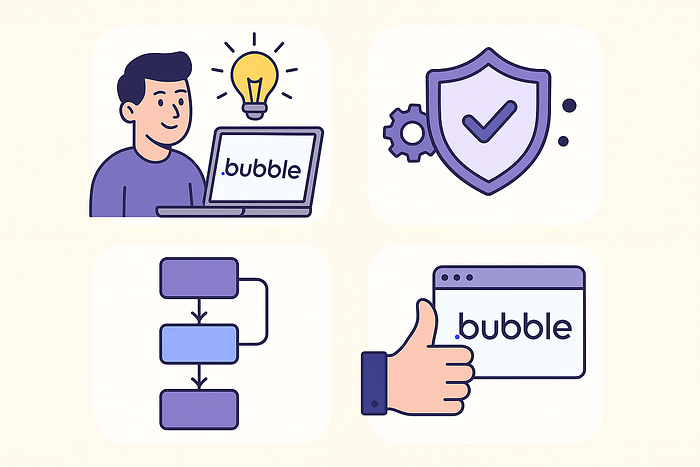
Ease of learning, reliability, process and fit with our purpose.
Factors to consider
Learning the tool
If you start learning Bubble today, it would take only three months to get to learn the skills needed to build a basic but meaningful web app with Bubble. Within 6–12 months, you can have a comprehensive understanding of the whole tool, get officially certified, and build full-stack web apps (more info here at our academy).
Get Will Ericksson’s stories in your inbox
Compare this with learning web development with code. It’s a lot faster to learn Bubble. Having everything (frontend, backend, development environment) on one cloud platform is a huge advantage here. There is a clear envelope. Learn everything within that envelope, and you’re sorted.
Fast forward to FIVE years into our journey of building with Bubble. The results of our experience are that we are REALLY fast. We can solve problems in minutes or hours that used to take days. We’ve invested the time. We know the tool backwards. We can do what we want faster in Bubble than any other way.
It would take a long time to get to this speed and efficiency with another tool, be it no-code, code or AI. While Bubble remains the best tool for many web application projects, it doesn’t make sense for us to invest another 1–5 years getting to expert status with a new tool, especially ones that are basically in a perpetual beta test. Even if another tool is just as good, if it ain’t broke, don’t fix it .
Reliability and trust
If you build a web application — or any technology really — reliability is key. Not only is reliability of the end product critical, but also reliability in the process. Can you deploy changes and be confident they will work? Can you fix issues reliably when they crop up? Reliability is king.
It’s easy enough for good developers to break an existing app when pushing new changes using code or no-code. Many people can’t even get AI coding assistants to build the app correctly in the first place, let alone risk pushing AI generated changes live without the certainly that they can fix it if it breaks existing functionality.
We know Bubble, we know where the potential pitfalls are, and we know how to mitigate them. Switching tools would require us to enter a zone of unreliability both due to our learning, and in the case of AI, due to the tools not yet being mature. We don’t put our clients through someone else’s giant beta test.
Established team process
While some of the process is largely agnostic, much of what we do is leveraging the interplay between our approach (agile, collaborative, lean, validating the solution with the target audience, startup/SME focused) and the nuances of Bubble (lightweight, technically simple, easy to make changes). This has taken us five years as an agency, working on many projects over tens of thousands of hours to build a process that includes robust product management, product design, development, testing, deployment and iteration.
Changing tools is not only (1) learning the tool and (2) being able to establish and trust that the tool can deliver the necessary reliability. It’s then (3) figuring out how to make it work within an efficient process that clients (whether external or internal) are willing to pay for and that generates them value. AI Tools are at an early stage here, and even with rapid technical advances, it’s going to take humans a lot of time to retool and reinvent their processes to support new tooling.
Alignment with why we started
We started learning Bubble and building our agency to work on our own digital products. Using Bubble now continues to aligns with why we started using Bubble five years ago. Even now that we’re out of the honeymoon phase — and the cool kids have moved onto the next thing — it makes no sense for us to switch tools.
If you had to start today — in 2025 (not 2020 as we did) — you have no prior experience with coding or product management — and you are looking at all of the possible choices of platform to start out building your very first app now — Bubble remains a strong choice. The path to learning Bubble is known, the tool is proven to be reliable, and it fits comfortably within established processes for building MVPs and web apps for SME/SMB.
If that sounds like you, it will be difficult to go past Bubble for the other no-code/low-code options on the market, or venture into the presently uncertain world of AI generated code.
Conclusion
Bubble does the job. Our agency/venture studio team knows Bubble. We can get to the result fast and reliably. And so we’re sticking with it.
Will is the founder of Momentum Group and Momentum Academy, an Australian based app developer working primarily with Bubble.
Where this story went
We spent five years mastering Bubble. Now we build with AI.
Momentum was one of the world's leading Bubble.io agencies — that's why we wrote this article. These days we build and migrate the same kinds of products with Claude Code: real, portable code your own team can amend with AI. If you're weighing up a move off Bubble (or any platform), we've made the journey ourselves.
Related posts
Legacy
**What a Founder’s 1,500-Prompt Failure Taught Me About AI and Vibe Coding**
Recently I had a call with a founder who was looking for advice about building with Bubble.io. He came to me after experimenting with vibecoding , an emerging…
Legacy
Why Learning Bubble Still Matters in the Age of AI
If you’ve been curious about building apps with Bubble.io, you’ve probably asked yourself at least once: “Isn’t AI going to do all of this for me soon?” It’s a…
Legacy
Are You Building a “Must-Have” SaaS? Here’s How to Know If Your Idea Will Make Customers Say, “Shut Up and Take My Money”
In the early stages of building a SaaS product, you probably already have a vision of how it will change lives, solve big problems, or fill gaps you’ve…