You have a thing you’ve always wanted to make.
A book. An app. An album. A body of work you’d actually hang on a wall. A podcast you’d be proud to publish. You’ve carried it around for years — and you never made it, because it needed a skill you don’t have, time you couldn’t find, or a team you couldn’t afford.
That excuse just expired.
The barrier was never the idea
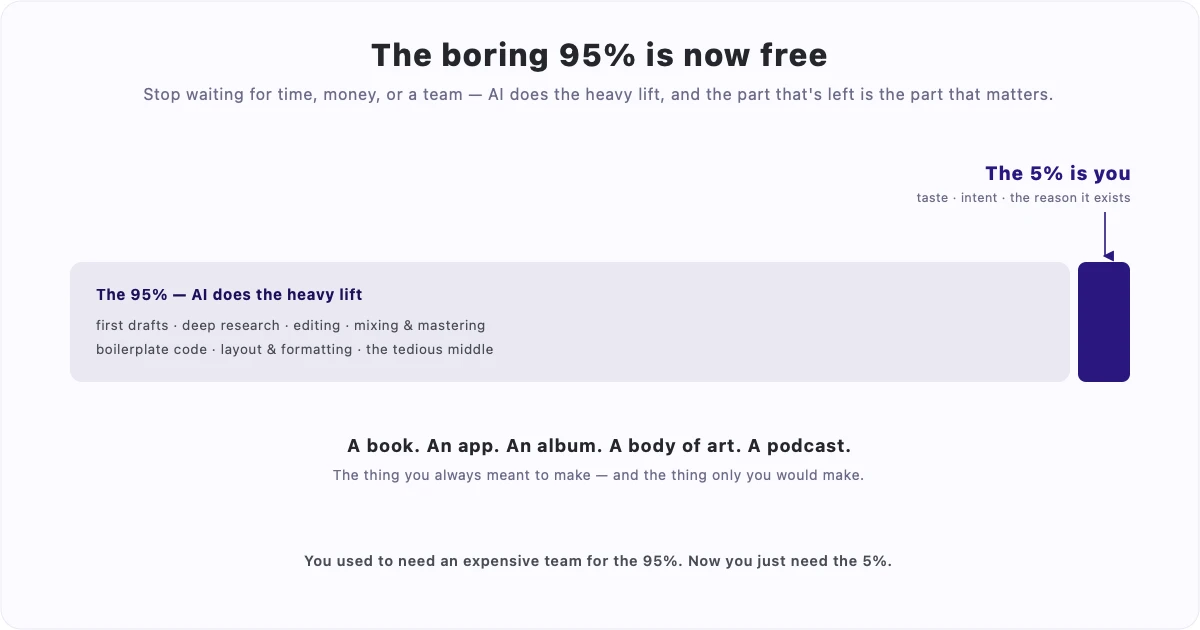
Here’s the thing nobody tells you about making something: the idea is the easy part. What stops people isn’t imagination — it’s the 95% of unglamorous craft between the idea and the finished thing. The second draft. The mixing and mastering. The boilerplate code. The research. The formatting. The tedious, skill-hungry, time-devouring middle that turns a spark into a real object in the world.
That 95% is what used to require an expensive team, or years of practice, or both. And that 95% is exactly what AI now does.
Which leaves the 5% that was always the point: taste, intent, the reason the thing should exist, and the judgement of whether it’s any good. That part is you — and it’s the whole game.
What AI actually is for a maker
Think of it less as a tool and more as the team you never had:
- A mentor. It teaches you the craft as you go — song structure, story arcs, colour theory, how the code works — at your level, on demand, without judgement. The expert tutor you couldn’t afford, available at 2am.
- A thought partner. It argues with your idea, finds the plot hole, suggests the bridge, names the thing you were circling. A collaborator with no ego and infinite patience.
- The heavy lift. The first draft, the refactor, the transcription, the layout, the hundred fiddly steps — done in minutes, so your energy goes to the decisions instead of the drudgery.
- The multiplier. One person can now do what took a studio, a band, a publishing house or a dev shop. Not as a gimmick — as a genuine collapse in what a single motivated human can produce.
Pick your thing
A book? Outline with it, pressure-test the argument, draft the chapters you dread, have it edit line by line — while every idea and every sentence that matters stays yours.
An app? Describe what it should do and build it with an AI writing the code, explaining as it goes. The thing you sketched on a napkin can be real and in your hands this month. (It’s literally how we build now.)
An album? Compose, arrange, produce and mix with AI in the room — learning as you make, turning “I have melodies in my head” into tracks you can actually release.
Art? Explore a hundred directions in an afternoon, develop a style, then execute the vision only you can see.
A podcast? Research, script, edit, produce and publish — the whole pipeline a network used to run, operated by one person with a point of view.
The honest part: the 5% is still everything
Let’s be clear, because it’s the difference between a wave of ambitious new makers and a flood of forgettable noise: AI does the 95%, but the 5% is what makes it worth existing. It will happily produce something competent and hollow if you let it drive. The taste, the intent, the specific reason you are the one to make this — that can’t be delegated, and it’s precisely what people will feel in the finished thing.
So AI doesn’t replace makers. It makes more of them — and it raises the floor, which means taste becomes the moat. Don’t confuse “AI made it easy” with “AI made it good.” Easy is the 95%. Good is you. This is the same truth that runs through everything we believe about this shift: the tools changed, the thinking didn’t, and we’re living through the golden age of the builder-generalist precisely because the people with something to say can now build it themselves.
So make the thing
The cost of trying has collapsed. The team, the time, the money, the “I wouldn’t know how” — all of it, gone as an excuse. The only scarce input left is the decision to begin.
Pick the one thing you’ve always meant to make. Make the smallest real version of it this weekend — one chapter, one screen, one track, one episode. Give the AI a role and go.
We built Momentum on exactly this belief: that AI puts real making within reach of people who were locked out of it, and that the interesting question is no longer can you build it, but will you. If the thing you want to make is a business, a product or a website, that’s what we’re here for. If it’s a book, an album or a wall of art — that one’s on you, and it’s never been more possible.
Be more ambitious. Make the thing.
If this sparked something, let's talk.
No pitch, no pressure — just a conversation about what you're working on.
Let's talkRelated posts
AI Strategy
Inverting the Approval Pyramid: A Governance Model for Bottom-Up AI
Traditional organisations route every new initiative up to a few executives for approval. AI makes experiments nearly free, so that gate becomes the constraint. Here's an operating model: a sandbox anyone can use, a register, a promotion path, AI-prepared approval briefs, and a smaller, sharper role for the top.
AI Strategy
Did AI Just Kill BI? What to Stop Paying For, and Where to Spend Instead
Traditional business intelligence spent most of its budget on integration: ETL, data wrangling and merging systems. AI has collapsed that cost. Here's what leaders should stop funding, what deserves the money instead, and the questions to put to your BI vendor.
AI Strategy
AI Isn't the Bottleneck. You Are.
AI can run 50 projects where you used to run 5. But your organisation can't absorb that. The real constraint on AI isn't capability — it's leadership bandwidth.