Bootcamp
Module 8 — Workflows practical: build a real onboarding flow

Photo by Akhmad Muzakir on Unsplash
Module 8 was deliberately different: almost no new theory, one substantial build. After seven modules of concepts, students proved they could assemble them — by building the screen where products win or lose their users.
Onboarding is the guided first-run experience that takes a new user from empty account to first value. It’s a workflow problem wearing a design problem’s clothes: steps, state, navigation rules and data capture, all of which must feel effortless.
The build, lesson by lesson
An introduction set the quality bar, then the assembly ran in the order professionals actually work: the template (structure first, always); navigation workflows (which step shows when, and the show/hide logic behind the progression); the onboarding step and help cards (guidance living beside the questions, not in a manual nobody reads); the forms themselves; navigation show/hide refinements; the data wiring — every answer saved to the right place as the user moves; and the finishing pass that turns “works” into “feels right”.
The quiet teaching move: navigation logic was built before the forms. Get the skeleton of steps working with placeholder content, then fill it — the exact opposite of how beginners do it, and the reason professional builds don’t collapse when a step gets added later.
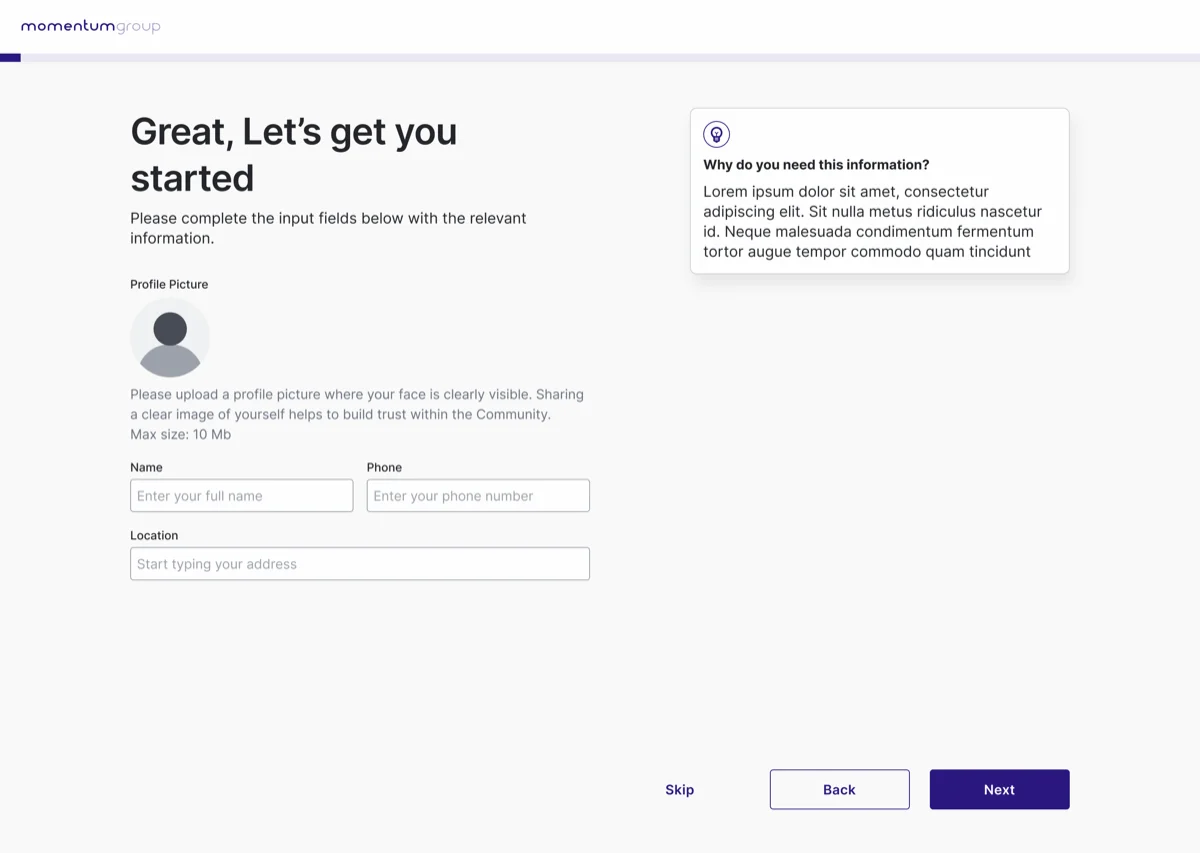 One step of the onboarding flow: a progress bar, a single focused question, a help card answering “why do you need this?”, and Skip / Back / Next. The stepper’s navigation was built before any of the forms — Module 8’s actual lesson.
Try it yourself
Design a three-step onboarding for any product: step one, who are you; step two, what are you trying to do; step three, first action inside the product. Build the stepper with dummy content until back/next/progress all work, then add real forms, then wire the saves. Notice how calm that order feels — that’s Module 8’s actual lesson.
This skill in the AI era
Onboarding is where AI-generated apps most obviously betray their origins — technically functional, experientially hollow. The state machine Claude Code writes in seconds still needs a human who knows what the steps should be and why. Sequencing, progressive disclosure, save-as-you-go: that judgement is the durable skill, and it’s exactly what we bring to AI product builds today. The whole arc, here.
If this sparked something, let's talk.
No pitch, no pressure — just a conversation about what you're working on.
Let's talkRelated posts
Bootcamp
A simple approach to data modelling
A four-step method for designing a database schema: identify entities, map relationships, choose fields. Taught through the CRM data model built in Bubble.
Bootcamp
API calls as actions vs data (and the planning checklist)
When to use Bubble API calls as actions versus data sources, a one-to-many auth pattern, and the planning checklist that keeps integrations from failing silently.
Bootcamp
Module 5 — Application architecture: pages, states and reusable pieces
Single-page vs multi-page apps, URL parameters, custom states, reusable elements — and a big practical building a main template with an expanding navigation drawer.