Bootcamp
Module 16 — Leading a team: from builder to professional

The final module made the bootcamp’s ambition explicit: it never intended to produce people who could merely operate a tool. It intended to produce professionals — people a client or employer could hand a product to. That’s a different job, and it has its own curriculum.
The lead’s shift: alone, you’re paid for what you build; leading, you’re paid for what the team builds and what you chose not to build. Scoping, sequencing and clarity become your highest-leverage work.
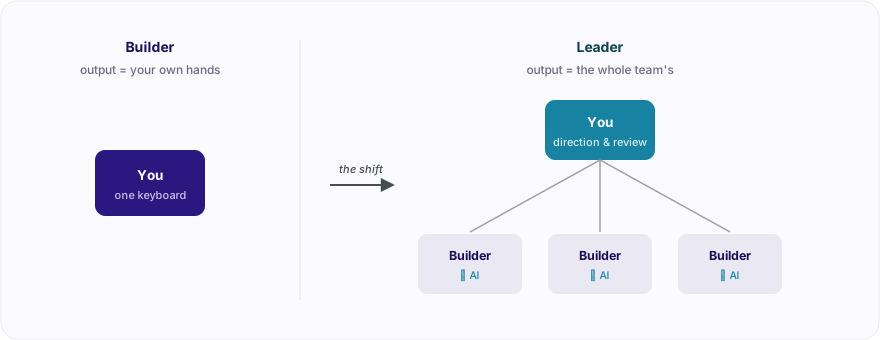 The shift the module is about: as a builder your output is your own hands; as a lead it becomes the whole team’s — and in the AI era every builder leads a team, because each person, you included, is amplified by AI.
The curriculum
Team structure — who does what on a real product team and how small teams overlap roles. Project styles and phases — discovery, build, launch, iterate, and matching structure to project reality. Product management as advocacy for the outcome (rhyming deliberately with Module 2’s advocacy for the user). Then the commercial spine of agency work: scoping, the product brief, and estimation from both ends — bottoms-up and detailed spec — with the professional insight that the gap between the two is a risk map. Finally the mechanics of many hands: remote work tools, collaboration plans, adding collaborators, version control — parallel work without overwriting each other — plus certification and the ecosystem as career context.
Try it yourself
Write a one-page product brief for something you want to build: problem, user, success measure, in scope, out of scope, constraints. Then estimate it twice — sum of parts, and gut-price of the whole page. Sit with the difference. That number is your optimism, quantified; leads are just builders who’ve learnt to price theirs.
This skill in the AI era
This module aged the best of all sixteen. With Claude Code, every builder now leads a team — the team just happens to be AI agents — and the job is exactly this syllabus: briefs (prompts are specs), scope, sequencing, review, version control. The better your product management, the better your AI output; we’ve watched it hold across every venture and client build since we made the switch. The bootcamp’s last lesson turned out to be its most durable: the tools were never the point — the thinking was. Full circle, here.
If this sparked something, let's talk.
No pitch, no pressure — just a conversation about what you're working on.
Let's talkRelated posts
Bootcamp
A simple approach to data modelling
A four-step method for designing a database schema: identify entities, map relationships, choose fields. Taught through the CRM data model built in Bubble.
Bootcamp
API calls as actions vs data (and the planning checklist)
When to use Bubble API calls as actions versus data sources, a one-to-many auth pattern, and the planning checklist that keeps integrations from failing silently.
Bootcamp
Module 5 — Application architecture: pages, states and reusable pieces
Single-page vs multi-page apps, URL parameters, custom states, reusable elements — and a big practical building a main template with an expanding navigation drawer.