Bootcamp
Module 14 — System operations: running software people rely on

Photo by Johnathan Kaufman on Unsplash
Nobody chooses a course for the operations module, and then it’s the module that saves them — usually within a month of their first real launch. Software that people rely on generates questions (“why didn’t my invoice send?”) that only operators can answer.
Operations is the craft of running live software: knowing what the system did (logs), changing what it holds (data operations), and adjusting how it behaves (settings) — all without breaking the thing people are using while they’re using it.
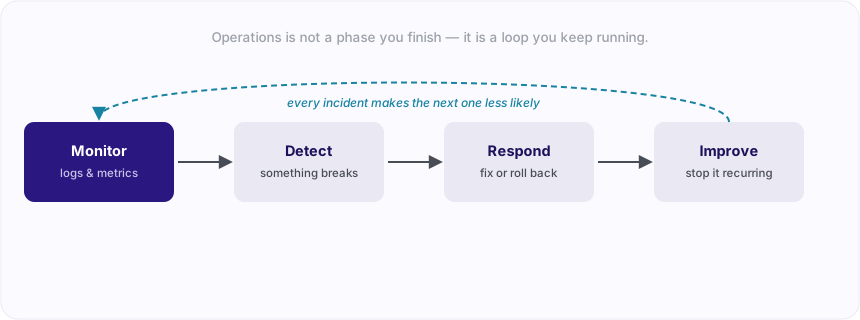 Operations as the loop it really is: watch the system (logs and metrics), catch what breaks, respond — fix or roll back — then improve so it can’t recur. Running live software is this cycle kept turning, not a phase you finish.
The curriculum
The diagnostic core: server logs and the scheduler log — the difference between “the app is broken” and “the 2 am job failed on record 3,117 with this error”. Students learnt to read them before touching anything, because acting without looking is how incidents become outages.
Data operations as a professional procedure: export data (backup before surgery), modify data, bulk actions, and worked scenarios — plus making content updates to a live app without collateral damage. The admin surface: limiting access, app and text language, plans, sub-apps for multi-tenant setups, and a clear-eyed lesson on plugins — third-party code is a dependency you’re marrying, so vet it like one. And the ethics-adjacent power tool: run as a user, for seeing exactly what they see when diagnosing their issue — with the responsibility that access implies.
Try it yourself
Open the logs of anything you run and reconstruct one recent hour: what jobs ran, what failed, what a user did. If you can’t tell, that’s the gap. Then do a fire drill: export a table, change one record via a bulk tool on a filter matching only that record, verify, restore. Rehearsing the procedure while calm is what makes it available when you’re not.
This skill in the AI era
AI can write code; it cannot own a production system — accountability doesn’t delegate. Logs, backups, safe bulk fixes, cautious plugin (now: dependency) judgement transfer directly to modern stacks, and they’re the difference between builders who ship and partners you can trust with live systems — the standard we hold on every system we operate for clients. Operational maturity is also half the pitch when rescuing an app whose original builder vanished at launch. The bigger story.
If this sparked something, let's talk.
No pitch, no pressure — just a conversation about what you're working on.
Let's talkRelated posts
AI Implementation
Build Your AI Middle Manager: Tracking, Chasing and Reporting on Autopilot
Good middle management is mostly diligence on a schedule: tracking commitments, chasing at the right moment, unblocking, and reporting upward. AI can carry 50 to 80 percent of it. Here's how we build an AI manager, and the line it never crosses.
AI Implementation
Does Your Organisation Have Its Own Anthropic or OpenAI API Key?
Most small businesses and for-purpose organisations are using AI through ChatGPT subscriptions. That's fine for personal use. But if you want AI woven into your operations, you need your own API key — and it's easier and cheaper than you think.
Bootcamp
A simple approach to data modelling
A four-step method for designing a database schema: identify entities, map relationships, choose fields. Taught through the CRM data model built in Bubble.