Legacy
Introducing Bubble.io: A platform that empowers small and medium enterprises (SMEs) to build their own custom, cloud-based software

Photo by Christian Boragine on Unsplash
Photo by Jon Tyson on Unsplash
Introduction
I started working with Bubble.io in mid-2020, after looking for an effective way to quickly build high-quality, scalable web applications. While my initial use case was a real estate platform, I quickly discovered that Bubble.io is a versatile tool that can solve all kinds of business problems quickly and efficiently.
While Bubble’s marketing focuses on the techy, startup world of ‘digital products’ — words that don’t mean much to old-school business owners — I’ve found that Bubble has a very strong value proposition for the small to medium enterprise (SMEs) space.
Photo by Clayton Cardinalli on Unsplash
What are SMEs?
In Australia, SMEs are defined as having between 5 and 200 employees. This means they will likely have in the range of $500k-$20mil turnover. They usually don’t have a dedicated IT team. If they do, it is likely to be small and versatile (“I fix your printer and run reports for management”).
Think of industries like Trades, Manufacturing, Wholesalers, Health Clinics, Work Health & Safety, Engineering, Education, Accounting, Printing, and Real Estate to name a few.
They are the tangible, everyday product and/or service businesses that are all around us.
SMEs typically use a range of “off-the-shelf” software as a service (SAAS) subscriptions. Often a Microsoft or Google business suite, as well as various industry-specific software packages, such as Salesforce or other CRM tools. Building custom software is usually considered to be beyond the reach of such businesses.
Photo by Markus Winkler on Unsplash
What are SME’s pain points with their software?
After talking with hundreds of potential clients, the pain points I keep hearing for SMEs about their current software are as follows:
- Not fit for purpose: “It only does 70–80% of what we need,” they say, and that is often after an expensive customisation process.
- The tools are poorly integrated and decentralised: Often multiple systems are used that don’t talk to each other as well as could be expected, and there is no central source of truth for the data.
- Expensive: “Our annual subscription costs are excessive”, especially for software priced by the head per month or year.
How does Bubble address these pain points?
Well — it doesn’t, directly. Bubble is not just another SAAS subscription, CRM, off-the-shelf product that competes with all of the sticky-taped-together solutions I keep hearing about. You don’t just “install Bubble” and off you go.
Instead, Bubble is a quick and affordable way to build your own custom software from scratch.
When you open a new Bubble App, you get a blank slate enabling you to build:
- your User Interface (the screens/buttons/forms),
- your Workflows (the actions that happen when the user interacts with your app),
- and your Data (which data you will store).
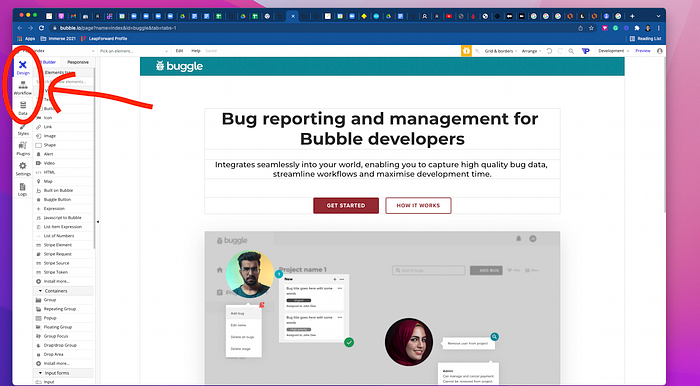
In addition, you can connect to other web services via their APIs, and even let other services connect to your API (an API is a way different web services transfer data over the internet). You can schedule tasks for the future, and even run recurring tasks at the frequency you choose.
Bubble can be accessed through both Desktop and Mobile web browsers. Some third parties also offer convenient options to ‘wrap’ Bubble apps for submission to the Apple and Google app stores.
Bubble doesn’t address your pain points… you do. You do this by building the software you need, exactly how you need it, to run your own unique business.
But I’m not a software developer
That’s fine. It’s easy enough to pick up the basics of Bubble in 3–6 months. One of my favorite client stories is of a US Based entrepreneur named Maddison who learned Bubble on a Bootcamp with me and would make changes to his company internal tool in near real-time, faster than he could scope up change requests for his three in-house full-stack devs.
But if you have other things to do (as a business owner, you surely do!) then there are others who can help as well.
Our agency Momentum Group has helped many businesses build software to automate their processes.
What types of projects can you build on Bubble to help SME’s?
Bubble is versatile. That being said, you should always try to use the right tool for the job. Out of the box, Bubble is a visual Web Application builder.
It builds web apps.
Think of a Web App as a place you store your data in the cloud, combined with a user interface builder, and a way of manipulating your data via workflows.
For old-timers (like me!!), it’s a bit like a cloud-based Visual Basic app with an Access (or SQL Server) database. It’s a bit like Wordpress without code. It’s an accessible way of getting into full-stack web development but without the hassle and overheads of time and knowledge required.
The kinds of things that it makes sense for SMEs to build on Bubble include customised:
-
Customer relationship management (CMS) software
-
Lead capture and automation (e.g. sending emails, text messages, generating invoices, capturing payments — in whatever sequence your business requires)
-
Enterprise resource planning (ERP) systems
-
Multi-role software — e.g. accessed by both customers and employees
-
Content Management / Learning Management (CMS/LMS) software
-
Financial Management / Accounting software
-
Software for consultants
-
Inventory Management systems
This list is not exhaustive.
Calculating Return on Investment
The most critical question for SMEs to ask when evaluating Bubble is: What is my Return on Investment (ROI)?
Costs
Firstly, the costs and benefits of a Bubble app should be evaluated over a 5 year period. Assuming you work with a reputable onshore agency like ours, the costs of building a Bubble app are most likely as follows (in USD):
Get Will Ericksson’s stories in your inbox
Initial build phase — $40,000-$100,000 for Project Management, Design and Dev (Say over a timeline of 10–20 weeks)
Ongoing costs — $129/month for hosting, $50/month for plugins and associated web services = $179/month * 12 months * 5 years
= $10,740 over 5 years for hosting.
Dev Support and minor enhancements — either in-house or on-call: $300 to $1,200/month * 12 months * 5 years
= $18,000 to $72,000.
Subsequent phase feature enhancements (optional)— one-off $30,000-$50,000.
Grand Total Costs = $68,740 to $232,740.
Important note: Unlike SAAS tools, when building on Bubble, you no longer pay a ‘per head’ cost for your end-users. If you have 50 team members, 10,000 customers, and 500 suppliers — there is no ‘per head’ cost for any of these user groups.
Gains
Secondly, evaluate the potential savings or increased opportunities by having your own custom software. Using a business with a headcount of 20 and a revenue of $1mil as our case study, potential gains include:
Automating processes and reducing administration by 1.0 full time equivalent (FTE) staff member = $40,000 * 5 years= $200,000.
Reducing expensive SAAS subscriptions = 20 staff * $50/month per head * 12 months * 5 years
=$60,000.
Reducing errors in data transcription, leading to revenue reductions: $1,000 per error * 12 errors per year * 5 years
= $60,000.
Re-engaging customers in an automated way that is too cumbersome to do manually resulting in a 5% increase in revenue: $1mil revenue * 5% * 5 years
=$250,000.
Doubling down on a successful niche, automating your unique value proposition and getting yourself out of the way in order to enable greater growth: $1mil revenue base now increases 25% every year for the next 5 years:
= $2.051mil (and minus a significant amount of stress on your side as the business owner).
Grand Total Gains= $60,000 to $2,621,000.
As you can see, the potential gains far outweigh the costs for a business looking to build their custom software on Bubble when measured over a 5 year period.
Are there better alternatives?
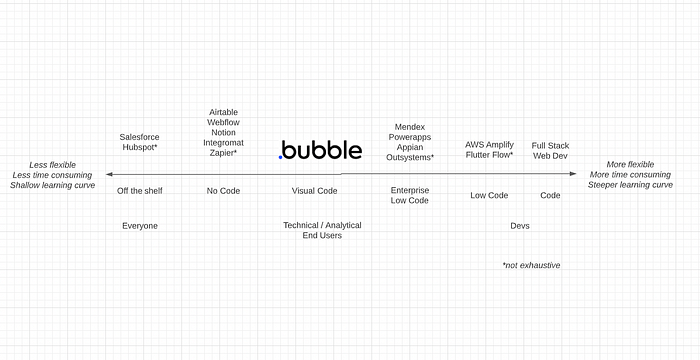
There are many alternatives. In the no-code and off the shelf SAAS categories, products are quicker to implement but much less flexible than Bubble. But these scenarios will present many compromises for SMEs.
There are also emerging low-code tools, targeted at developers like AWS Amplify and FlutterFlow. However, these give more control to the developer and have a corresponding decrease in speed and cost. Enterprise low code options like Outsystems have annual license costs that are prohibitively high for small and some medium enterprises (their pricing models are targeting large enterprises).
Then of course there is full-stack web development, and this is between 2–5x the cost and timeline as a Bubble project.
Bubble.io is currently the best middle ground with the flexibility you will need to handle current and future use cases, with the time and cost savings of no-code. The license and hosting fee for Bubble is negligible compared to enterprise low-code competitors.
What are the risks?
Risk 1: Finding great developers
The biggest risk with Bubble is that it can be hard to find really great developers who can not only build the initial solution but do so in a way that is scalable, reliable, maintainable, and secure.
Because Bubble pitches at the startup and minimum viable product (MVP) market, there are many developers who have not had to maintain products over a long period of time with a real user base.
Because we believe in the potential of Bubble so much, we have started Momentum Academy to teach developers to use Bubble to its full potential.
Risk 2: Project Management
Scoping projects is difficult, and keeping delivery to time and budget is proving a challenge for developers in the Bubble ecosystem, as many Bubble developers haven’t emerged from careers in software development.
We continually hear stories of projects that have gone over time and budget, even by some of the biggest names on the Bubble agency page. High expectations abound in the Bubble ecosystem and underquoting is rife.
Don’t push your developer for a cheaper quote or a faster timeline. Allow them to produce a quote and justify it by showing you their pricing methodology. Organise a small test project to see how the working relationship will be. Discuss changing the scope to meet your budget, and return for a Phase 2 should a smaller Phase 1 go well.
A freelancer is a great option if you are happy to take on the risks associated with Project Management. An agency is a better option if you would like to delegate management and a degree of risk to a professional, and also have a smoother experience of the whole process.
Contact Momentum Group to advise whether Bubble is the best tool for your particular SME project and to undertake a scoping exercise to determine a reasonable time and cost.
Do I own the codebase?
Yes.
One thing I get asked frequently is “who owns it”? Unlike SAAS vendors who do customisation, you own the codebase of a Bubble app. In practical terms, we as an Agency will Transfer ownership of the Bubble app to your Bubble account on completion of the initial phase and final payment.

Transferring a Bubble App is as simple as adding the new owner’s Bubble account email and pressing Transfer.
Upon Transfer, you will have ultimate administrative control of your data, your codebase, and your entire app. You can then grant access to your developer to perform ongoing maintenance and future feature requests.
For advice about the security configuration of your Bubble app, or information about how to give people appropriate levels of access (we’ve seen this go wrong many times as well!), please contact us.
Again as you own the codebase, there is no per head cost you must pay for each user of your software. You simply pay the hosting cost — for which we recommend the Professional plan in most cases ($129/month).
Improving your business valuation or offering your system through franchising
Another aspect of developing your own software, aside from the immediate projected financial benefits, is that businesses with their own proprietary software may be valued higher on sale or exit.
Systemizing your current “stack” of SAAS through a centralised, internal business tool may also add to the value proposition for potential franchisees who may wish to “buy” your business formula, ready-made with its own software.
Financing
Given that many businesses will tangibly benefit from building their own lightweight software on Bubble, exploring IT Finance options will help businesses to turn a capital expense into an operating expense. Rather than front up the investment into your software, a better approach may be to finance your software into a monthly cost that is tied to the likely lifecycle of the software.
Conclusion
Bubble.io is an ideal tool for SMEs. It is lightweight, full-featured, and very economical to run. If offers a strong value proposition to many SMEs with inefficient information processes and poorly configured SAAS tools.
Contact Momentum Group to determine the suitability of Bubble for your use case, to explore your potential ROI, and to provide a cost/timeline estimate to build and deploy your SME’s own custom software.
Looking to learn and build Bubble apps yourself? Join us at Momentum Academy
Where this story went
We spent five years mastering Bubble. Now we build with AI.
Momentum was one of the world's leading Bubble.io agencies — that's why we wrote this article. These days we build and migrate the same kinds of products with Claude Code: real, portable code your own team can amend with AI. If you're weighing up a move off Bubble (or any platform), we've made the journey ourselves.
Related posts
Legacy
**What a Founder’s 1,500-Prompt Failure Taught Me About AI and Vibe Coding**
Recently I had a call with a founder who was looking for advice about building with Bubble.io. He came to me after experimenting with vibecoding , an emerging…
Legacy
In the brave new world of AI coding: Why we’re doubling down on Bubble.io in our agency/venture studio.
Introduction Tool obsession It’s 2025. There’s lots of excitement/hype about generative AI and coding. There’s also a small ocean of opinions about the various…
Legacy
Why Learning Bubble Still Matters in the Age of AI
If you’ve been curious about building apps with Bubble.io, you’ve probably asked yourself at least once: “Isn’t AI going to do all of this for me soon?” It’s a…