Marketing
The AI-Native Marketing Stack: Replacing SaaS With AI, Git and No Lock-In
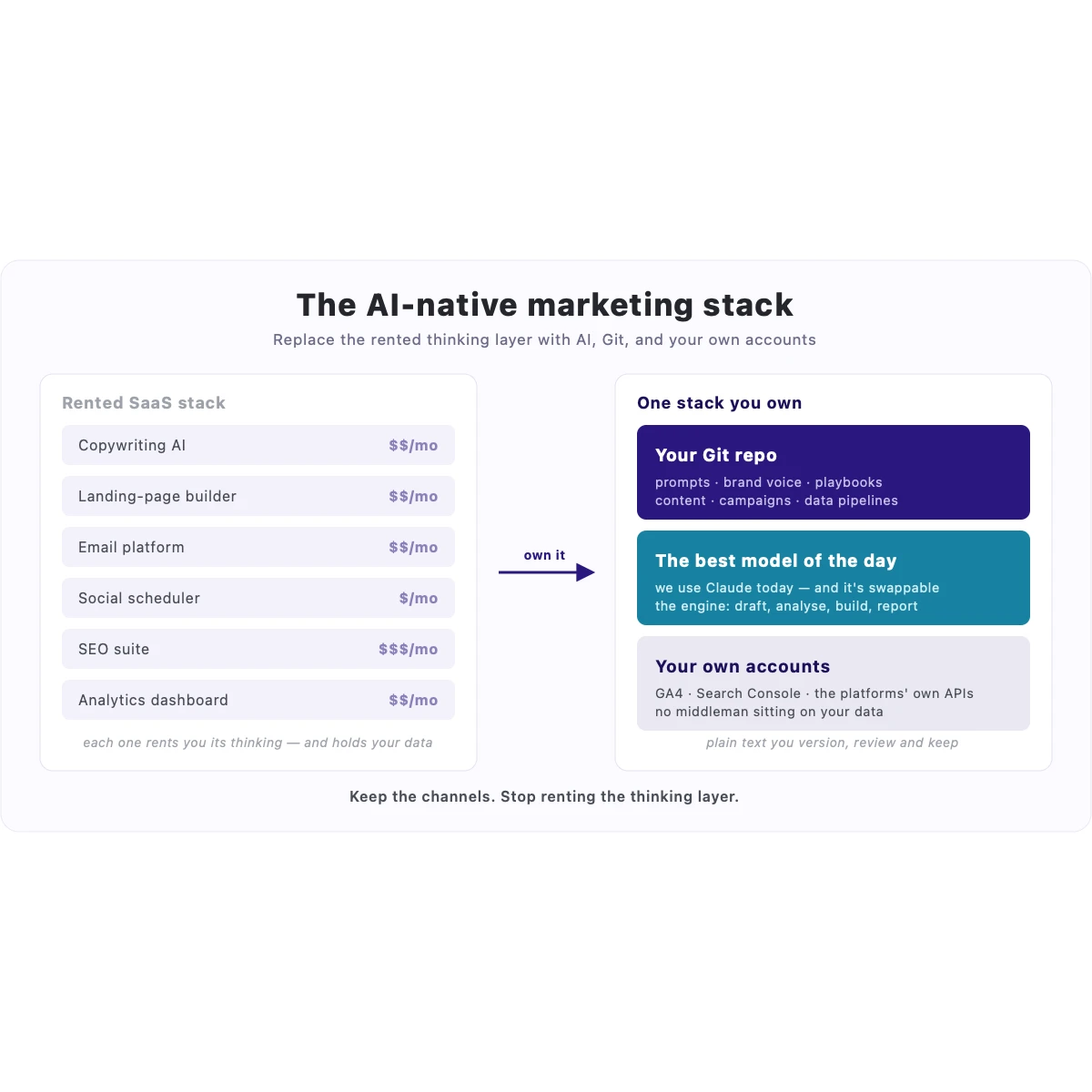
Open a typical marketing team’s billing page and you’ll find a stack of rentals: a copywriting AI, a landing-page builder, an email platform, a social scheduler, an SEO suite, an analytics dashboard, a form tool. Each is $30–300 a month. Each holds a slice of your data, your templates and your workflows — and each is a little harder to leave than the last.
That’s not a marketing stack. It’s a stack of tenancies.
There’s now a different way to build it, and we run Momentum’s own marketing on it: go direct to the model. A capable AI model — we work with Claude today and rate it highly, but any frontier model will do — plus a Git repository plus your own platform accounts replaces most of the “thinking layer” you’re currently renting. Here’s the argument, including where it doesn’t apply.
The repo is the stack
The core move is to keep the valuable part — the thinking — as plain text in a Git repository you own. Your brand voice, tone rules and banned words. Your campaign playbooks. Your prompts. Your content, your landing-page source, your data-pipeline scripts, your reporting templates. All of it, versioned.
Once it’s text in Git, three things change:
- It’s owned and portable. No export button to hunt for, no “contact us to cancel.” It’s your repository; it goes where you go.
- It’s reviewable. Every change is a diff. You can see what changed, who changed it, and why — and undo it in seconds. “Who edited the email template?” stops being a mystery and becomes
git blame. - It composes with AI. The model reads the repo and edits the repo; you review the diff and merge. Marketing operations become engineering-grade — the discipline software teams have had for twenty years, finally applied to marketing.
The model is the engine, not another line item
Where a SaaS gives you a narrow tool with a monthly fee, a capable model gives you the underlying capability that tool wrapped. Draft and repurpose content in your own voice. Write landing pages — we ship ours as Astro on free hosting. Analyse a GA4 or Search Console export and tell you what actually moved. Generate the monthly report. Turn one webinar transcript into ten assets. One engine, many jobs — instead of a different subscription for each.
That’s the difference between renting six narrow tools and owning one broad capability you point at whatever needs doing.
Model-agnostic by design — the part that matters most
Here’s the strategic core, and the reason this isn’t just “SaaS with extra steps.”
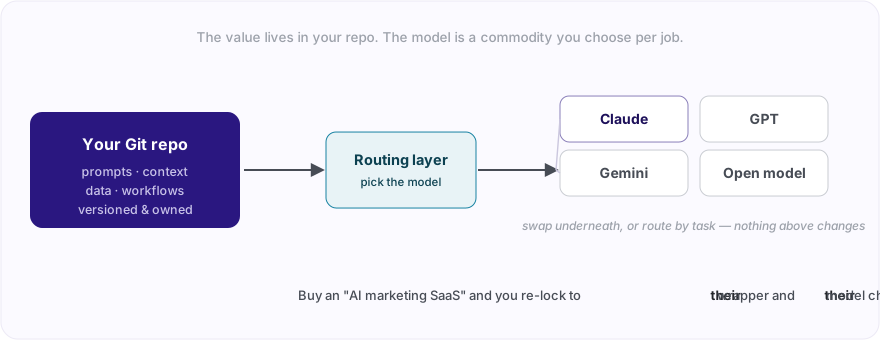
Because the value lives in your repo, not in a vendor’s interface, the model becomes a swappable commodity. We work with Claude today — we like it, and right now it’s the best tool for most of what we do — but that’s a preference, not a dependency. If something better ships tomorrow, or a particular task is cheaper on another model, you route it there. Nothing above the model changes — the prompts, the context, the workflows, the review process all stay exactly as they are. You back the best model of the day, not a SaaS vendor’s bet from three years ago.
This is the precise inverse of SaaS lock-in. And it’s why buying an “AI marketing platform” is a trap dressed as progress: you’ve simply re-locked yourself, this time to someone else’s wrapper and their choice of model. Own the layer above the model, and the model works for you instead of the other way round.
What you actually replace — and what you don’t
Let’s be honest, because the honest version is more persuasive than the hype. This is not “cancel everything.”
Replace — the rented thinking-and-convenience layer:
- Copywriting AIs → a capable model, pointed at your brand-voice files
- Landing-page builders → real pages the model writes, on hosting you own
- Some reporting dashboards → your own GA4/GSC data plus AI analysis
- Scattered content-ops tools → one repository that holds the lot
Keep — the infrastructure that does a genuinely hard job:
- Email sending and deliverability (getting to the inbox is specialised work)
- The ad platforms and the social networks themselves
- CRM and payments, where they earn their keep
The point isn’t to rip out every tool. It’s to stop renting the layer you can now own, and keep the ones solving problems that are actually hard.
The maths — and the bigger number
Rough small-business figures: a mid-sized marketing stack runs $500–2,000 a month and rises with every seat and every “AI add-on.” The AI-native version is a model subscription or metered API usage, near-free hosting, and the platform accounts you already pay for anyway.
But the saving isn’t the real story. The real story is the asset. Every month you feed the repo, it compounds — more playbooks, sharper prompts, a better-defined voice, reusable pipelines. A subscription you rent depreciates to nothing the day you stop paying. A repository you own appreciates the longer you run it.
The honest caveats
- It’s a capability, not a button. You need someone comfortable with Git and AI — in-house or a partner. If your current stack is cheap and working, don’t tear it out to prove a point.
- The hard infrastructure still needs care. Deliverability, compliance and channel APIs don’t get magically absorbed.
- The payoff is over time. This is build-and-own, not plug-and-play. The case is strongest when the subscriptions are stacking up, the lock-in is starting to bite, or you simply want marketing to move at the speed of a prompt.
This is how we work
We run our own marketing this way, and we build it for clients — the same principle that runs through everything we do: own the code, own the data, no lock-in. If your marketing has quietly become a pile of rented subscriptions, there’s a version of it you own outright.
Start with the zero-dollar GTM stack, read why SaaS stickiness is breaking down, or see how we put it to work in AI marketing automation and everything we build with AI.
If this sparked something, let's talk.
No pitch, no pressure — just a conversation about what you're working on.
Let's talkRelated posts
AI Strategy
When Your Software Vendor Sells You AI: A Four-Question Test
Your ERP, CRM and accounting vendors are all adding AI tiers, because the per-seat model that built them is under threat. Before you buy, run four questions. Keep each vendor as your system of record, get the data out through its API, and use whichever AI is best this year.
Marketing
llms.txt, robots.txt and What AI Actually Reads on Your Website
robots.txt decides whether AI assistants can see your site at all. llms.txt is a newer, optional file that tells them what matters. Here's what each does, the AI crawlers worth knowing by name, the ways sites block them by accident, and an honest view of how much llms.txt helps.
AI Implementation
The AI-Native Stack for a Small Business or Not-for-Profit
Before you subscribe to a website builder, an email tool, a scheduler and a CRM, consider four layers instead: one Google Workspace, a website you own, Claude connected to your data, and Canva. Here's the architecture, what it replaces, and where it stops.