Bootcamp
Module 13 — Testing and go-live: shipping like a professional

Most courses end at “it works on my machine”. The bootcamp gave shipping its own module, because the distance between a working build and a launched product is made of specifics — and every one of them is on somebody’s outage story.
Going live is a checklist, not a feeling. Professionals don’t launch when the app seems done; they launch when the list is done — testing, keys, domain, security review, deploy, and a measurement plan for what happens next.
Testing first
Types of testing gave the vocabulary; testing in Bubble made it concrete; writing testable software planted the deeper idea that testability is a design property — small pieces, predictable states, visible outcomes. Then the lesson with the highest yield per minute: simulate real-world factors. Your app on your fibre, your 27-inch screen, your muscle memory is not your app. Slow it down, shrink it, hand it to someone cold. Testing and project management tied bugs to a workflow instead of a memory.
Then the launch sequence
In order: the go-live checklist; a custom domain; Google Maps API keys; SendGrid keys and template (transactional email is a launch item, not a nice-to-have — password resets are load-bearing); favicon; page and SEO settings; a security review — privacy rules read one final time with launch eyes; choose a plan sized to reality; duplicate the app so there’s a rollback; deploy live. And then the module’s smartest inclusion: measure user adoption — because launch isn’t the finish line, it’s the starting gun on finding out whether people use the thing.
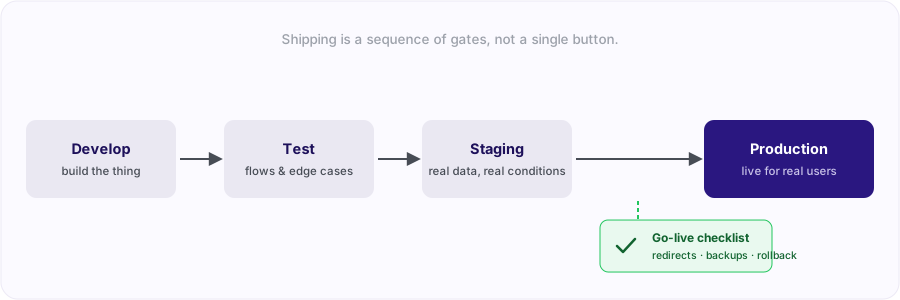 Going live is a sequence of gates, not a single button: work earns its way from development through testing and a staging environment, clears a go-live checklist — redirects, backups, a rollback plan — and only then reaches production.
Try it yourself
Write your go-live checklist now, mid-build, while it’s cheap. Steal the sequence above, add your product’s specifics (payments? file storage? legal pages?), and put a measurement beside it: the one number that means “people are actually using this”. A launch you can’t measure is a party, not a milestone.
This skill in the AI era
Deployment mechanics changed — we ship to Netlify with automated builds now, and honestly it’s easier — but the checklist discipline is untouched: keys, domains, email, security review, rollback, adoption metric. It’s exactly how we run go-lives for client builds and every migration cutover, where the checklist literally protects years of SEO. How the whole practice evolved.
If this sparked something, let's talk.
No pitch, no pressure — just a conversation about what you're working on.
Let's talkRelated posts
Bootcamp
A simple approach to data modelling
A four-step method for designing a database schema: identify entities, map relationships, choose fields. Taught through the CRM data model built in Bubble.
Bootcamp
API calls as actions vs data (and the planning checklist)
When to use Bubble API calls as actions versus data sources, a one-to-many auth pattern, and the planning checklist that keeps integrations from failing silently.
Bootcamp
Module 5 — Application architecture: pages, states and reusable pieces
Single-page vs multi-page apps, URL parameters, custom states, reusable elements — and a big practical building a main template with an expanding navigation drawer.