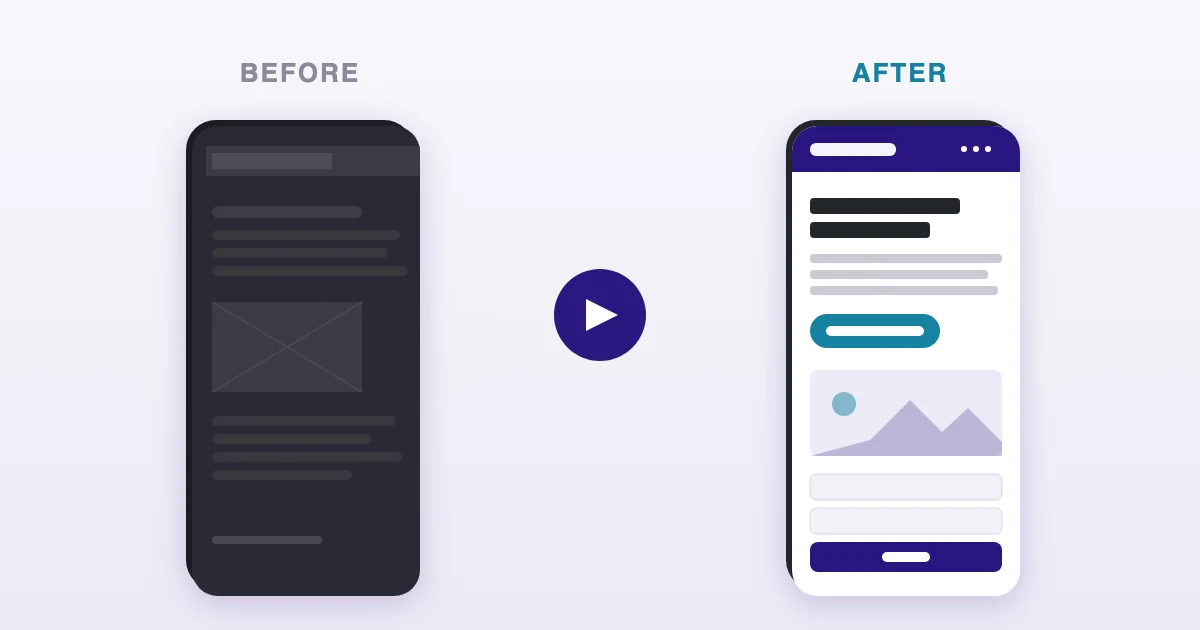
There’s a particular kind of website you’ve almost certainly used this week. You looked up a local charity, a community group, a tradie, a café — and the site fought you the whole way.
The menu didn’t work on your phone. The text was grey on a slightly-less-grey background, unreadable in daylight. You scrolled looking for a phone number or a form and found neither, just a wall of text and a photo from 2014. Maybe you couldn’t find the site at all, because searching the organisation’s own name turned up everything except them.
We see it constantly. And the frustrating part is that behind a lot of these sites are people doing genuinely good work — not-for-profits running real programs, small businesses that are excellent at what they do — being quietly let down by the one thing that’s supposed to bring people to their door.
In a hurry? This whole article leads to one offer: we’ll rebuild a simple website for free for Australian not-for-profits and small businesses. See the free website rebuild →
A website isn’t a brochure. It’s a bucket — and most are leaking
It’s easy to think of a website as a digital pamphlet: put it up, tick the box, move on. But a website has one job — to turn a stranger who’s interested into someone who acts. Donates. Volunteers. Signs up for the program. Books the job. Sends the enquiry.
Every friction point between “interested” and “acts” is a hole in the bucket. A broken mobile layout is a hole — more than half your visitors are on a phone. Text nobody can read is a hole. No clear next step is a hole. No contact form is a big one. And if you can’t be found in search at all, the bucket never gets filled in the first place.
For a small business that’s lost customers. For a not-for-profit it’s lost donors, volunteers and participants — people who wanted to help and couldn’t work out how.
The five-minute self-audit
You don’t need us to tell you whether your site is working. Pull it up on your phone right now and score yourself honestly:
- Does it work on mobile? Not “does it load” — does it actually work? Tap the menu, read the text, try to find your contact details with your thumb. If it’s a pinch-and-zoom exercise, that’s most of your visitors giving up.
- Can people actually read it? Dark text on a dark background, tiny fonts, low contrast — these aren’t just ugly, they lock out anyone with less-than-perfect eyesight. Readable and accessible are the same thing.
- Is there a clear next step? A visitor who’s convinced should never have to hunt for what to do next. One obvious button — Donate, Get in touch, Book now — beats a paragraph explaining how to email you.
- Is there a form? A phone number and an email in the footer leak leads. A simple form that lands in your inbox captures the person while they’re interested, and tells you where they came from.
- Can you be found? Search your own name, then search what you actually do (“youth mentoring Parramatta”, “electrician Newcastle”). If you’re nowhere, the best site in the world isn’t helping you.
If you flinched at more than one of those, your website is costing you — and it’s fixable.
So we’re going to fix some of them. For free.
Here’s the offer, plainly: Momentum will rebuild simple websites for Australian not-for-profits, for-purpose organisations and small businesses — for free.
Not a discount. Not a trial. A proper rebuild of a simple site: clean, fast, readable, works perfectly on a phone, easy to find, with a clear path to get in touch. The kind of site that stops leaking.
We can do this because we build with AI, and we’ve got very good at it. A simple site that once meant weeks and thousands of dollars is now an hour or two of focused work for us — as long as you can tell us what you want and hand over what you’ve got.
Why on earth would we do that?
Fair question — so here’s the honest answer, no spin.
We’re a young consultancy, and the things that matter most to us aren’t things you can buy: a portfolio of real, live Australian websites; testimonials from people we’ve genuinely helped; and the word-of-mouth reputation that comes from doing good work for good organisations. Building a simple site well costs us an hour or two. The goodwill it earns is worth far more than that — and far more than the same time spent running ads at strangers.
So it’s a trade, and we’re upfront about both sides. You get a website that finally works for you. We ask for two small things in return: we’d love to leave a small “Made by Momentum” credit in the footer (negotiable — talk to us), and if you’re happy, a short testimonial or Google review. That’s the whole deal.
How to know if you qualify
We’re keeping this simple on purpose. The free rebuild is for simple sites — a handful of pages that tell people who you are, what you do, and how to reach you. If your project needs an online store, member logins, event ticketing, bookings or a custom database, that’s beyond “simple” — but get in touch anyway and we’ll tell you honestly what’s free and quote the rest fairly.
The two things that keep it fast and free:
- You can tell us what you want in a normal email conversation — no formal brief required.
- You can share what you’ve got — your logo, your words, a few photos.
That’s it. When you reach out, we’ll send you a short checklist so you can see straight away whether your site fits the free rebuild or needs a quote. No long forms, no obligation, no pressure.
If you know an organisation that needs this
You probably thought of one while reading — the community group with the site stuck in 2014, the small business that does brilliant work and hides it behind a broken homepage. Send them this. It might be the most useful thing you forward all month.
Ready to see if you qualify? Get in touch — tell us a bit about your organisation and your current site, and we’ll take it from there.
If this sparked something, let's talk.
No pitch, no pressure — just a conversation about what you're working on.
Let's talkRelated posts
Marketing
Building a Website When You Don't Have Good Photography
Designers, builders, architects and other visual businesses often stall their website for months waiting on a photo shoot. Don't. Here's how to take stock of what you actually have, use written expertise and overlays to carry the load, and launch something that helps people decide.
Marketing
GEO, LLMO, AEO: Getting Recommended by AI, Explained Simply
New jargon — GEO, LLMO, AEO — for one simple idea: being the business an AI assistant recommends when someone asks. Here's what it means in plain English, why it matters even for a small local business or charity, and what to actually do.
Marketing
Do You Know Where Your Leads Come From?
When business is good it's easy to ignore lead flow. But the moment you hit a dry spell, knowing exactly which marketing effort produces which leads is the difference between pulling a lever and guessing. Here's how to capture it — and what we do across every site we run.