Here’s a question every business owner should be able to answer instantly, and most can’t: where did your last ten leads come from?
Not “marketing, probably.” The specific answer. Which came from Google, which from a referral, which from that blog post, which from the ad you’re paying for right now. If you can’t answer it, you’re flying a plane with the instruments taped over — and it’s fine right up until the weather turns.
The trap: it only feels optional when things are good
When the pipeline’s full, lead flow is easy to ignore. Work comes in, you’re busy, and nobody stops to ask why it’s coming in. That’s exactly when the discipline slips.
Then one quarter it goes quiet. And the question that decides whether you recover fast or panic is: which lever do I pull? More content? Turn the ads back up? Chase referrals? Revisit SEO? If you’ve been tracking, you know which channel actually produces clients and you pull that lever with confidence. If you haven’t, you’re guessing with money — and you can’t retroactively collect data you never captured. The best time to instrument your lead flow was when things were good. The second-best time is now.
The ways to actually know
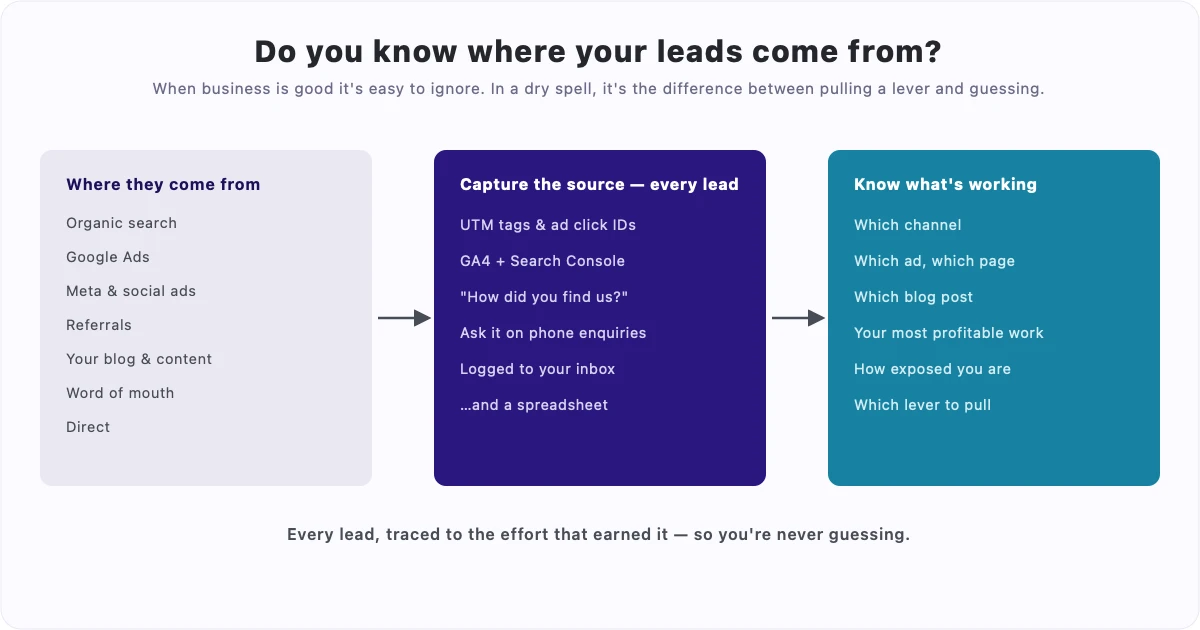
There’s no single magic source. Knowing where your leads come from is a handful of cheap, boring habits stacked together:
- GA4 — where your site traffic comes from, and which pages turn visitors into enquiries.
- Search Console — the actual search queries and pages bringing you organic visitors.
- UTM tags — on every link you control (emails, social posts, your own cross-links), so analytics knows precisely which one sent each visitor.
- Ad click IDs —
gclidfrom Google,fbclidfrom Meta, stamped automatically, tying a lead back to the exact ad and campaign. - A “How did you find us?” field — the one signal analytics can’t see, straight from the person’s mouth.
None of these is expensive. All of them are useless if you don’t capture and keep what they tell you.
What we do across our five sites
We don’t just recommend this — we run it on every Astro site in our own group. Each one has GA4 and Search Console wired in from day one. Links we control carry UTMs — right down to the small “Built by Momentum” credit in the footers of sites we build, tagged so referral traffic between our properties is attributable rather than lumped into anonymous “direct.” Contact forms capture the landing page, the campaign, the click ID where there is one, and a plain “how did you find us?” And critically, none of it lives only in a dashboard.
Capture it at the point of enquiry — inbox and spreadsheet
Here’s the part people skip. When a lead comes in through your contact form, the notification email you get should carry all of it: which page they were on, the UTM or campaign, the click ID, their “how did you find us?” answer, the date. And that same record should drop into a spreadsheet — yes, you need a spreadsheet — one row per lead.
And when the phone rings? Ask. “How did you hear about us?” “Were you looking at a particular page?” Phone and word-of-mouth enquiries are invisible to every analytics tool on earth; the only way they enter your data is if a human asks and writes it down. One line in the spreadsheet.
Do this and something quietly powerful happens: when a lead becomes a client, you can look back and see “oh — that one came from the ad,” or “that came from the bootcamp post,” or “that was a referral from the Boutique site.” You’ve connected effort to outcome.
Then let it compound
A spreadsheet of leads and their sources is already worth more than most businesses have. But it gets better with time:
- Add the outcome to every row — did it become a client, how big, how profitable? Now you’re not measuring leads, you’re measuring revenue by source, which is the only version that matters. The channel with the most enquiries is often not the one with the best clients.
- Analyse it with AI. Once the data’s being logged, point AI at it: which sources convert, which produce your most profitable work, which flatter you with volume and disappoint on value. Build a simple dashboard you actually look at. (It’s the same principle as owning your marketing data instead of renting it — the value is in the record you keep.)
- See your concentration risk. If 70% of your good clients come from one channel, you’re one algorithm change away from a very bad quarter. Attribution doesn’t just tell you what’s working — it tells you how exposed you are, so you can deliberately build a second and third channel before you need them.
The bottom line
Marketing without attribution is just spending and hoping. With it, every pound and every hour becomes a testable bet: you know what’s working, you double down on it, you cut what isn’t, and you’re never caught flat in a downturn wondering which lever does anything.
So, honestly — do you know where your leads come from? As a business owner, you need to. It’s exactly what we build into every site we ship and every marketing setup we run: the plumbing that turns “leads, probably from marketing” into a number you can act on. If yours is taped over, let’s fix that.
If this sparked something, let's talk.
No pitch, no pressure — just a conversation about what you're working on.
Let's talkRelated posts
Marketing
Building a Website When You Don't Have Good Photography
Designers, builders, architects and other visual businesses often stall their website for months waiting on a photo shoot. Don't. Here's how to take stock of what you actually have, use written expertise and overlays to carry the load, and launch something that helps people decide.
Marketing
We'll Rebuild Your Website — Free
Too many Australian not-for-profits and small businesses are running websites that break on mobile, hide their contact details, and can't be found in search. We're offering to rebuild simple ones for free — here's why, and how to know if yours qualifies.
Marketing
GEO, LLMO, AEO: Getting Recommended by AI, Explained Simply
New jargon — GEO, LLMO, AEO — for one simple idea: being the business an AI assistant recommends when someone asks. Here's what it means in plain English, why it matters even for a small local business or charity, and what to actually do.