Marketing
GEO, LLMO, AEO: Getting Recommended by AI, Explained Simply
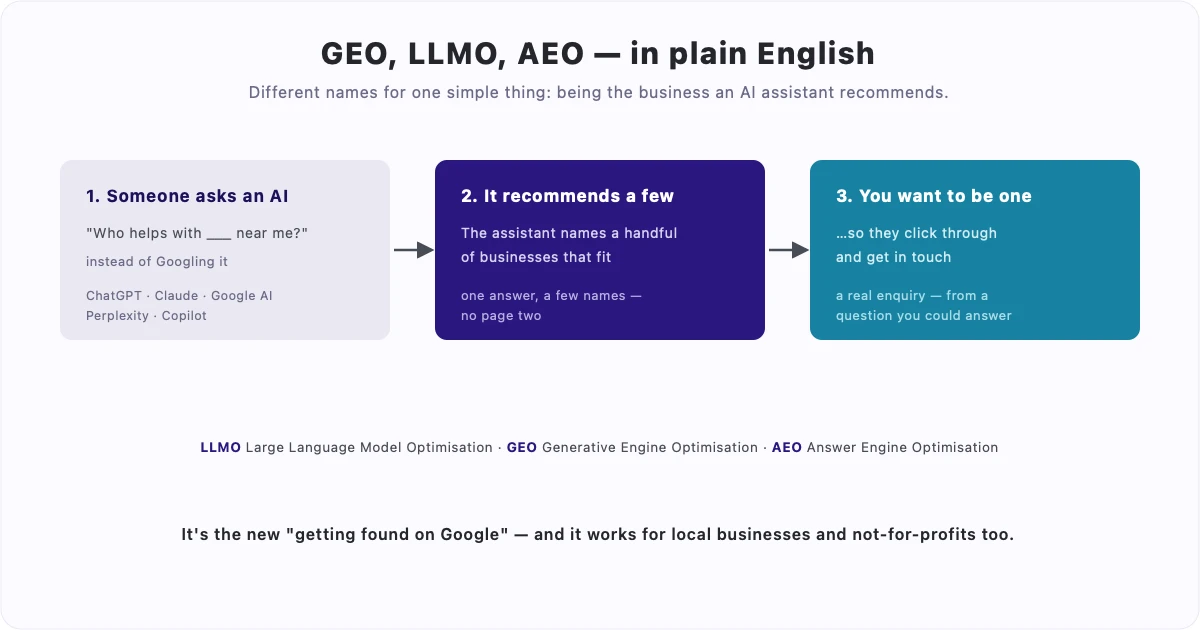
You’ve heard of SEO — getting found on Google. There’s a newer thing now, and it’s arrived with three confusing acronyms: GEO, LLMO, AEO. People throw them around like you’re supposed to already know what they mean.
Here’s the good news: they’re all the same simple idea, and you don’t need to be technical to get it.
What the letters actually mean
- LLMO — Large Language Model Optimisation
- GEO — Generative Engine Optimisation
- AEO — Answer Engine Optimisation
Three names, one meaning: making sure that when someone asks an AI assistant a question your business could answer, you’re one of the names it gives them.
That’s it. Where SEO is about ranking on Google, this is about being recommended by AI — ChatGPT, Claude, Google’s AI answers, Perplexity, Copilot. Different place, same goal: be the one people are pointed to.
Why it matters — even for a small local business or a charity
More and more, people don’t Google — they ask. “Who does bookkeeping for tradies near me?” “What’s a good men’s support group in Melbourne?” “Where can I get help with a home-insurance claim?”
The AI doesn’t hand back ten blue links. It gives one answer with a few names in it. You want to be a name. If you are, you get the enquiry. If you’re not, the person never even knows you exist — there’s no page two to be found on.
And this isn’t a big-brand thing, or a someday thing. It’s happening now, for small, local, community organisations.
It’s already happening — a real example
We build and run the website for the Centre for Men and Families, an Australian not-for-profit. A little while ago we added one small thing to their contact form: a “how did you find us?” question.
Last weekend, several people enquired — and chose “AI assistant (e.g. ChatGPT, Claude)” as how they’d found the charity. Real people, looking for a men’s support group, who asked an AI, were pointed to CFMF, and reached out. Not a marketing experiment. Not a big brand. A community not-for-profit, getting genuine enquiries because it turned up in an AI’s answer.
(That “how did you find us?” question is the same one we bang on about here — because without it, those enquiries would just look like anonymous “direct” traffic, and you’d never know AI was working for you.)
How it actually works (simply)
AI assistants decide who to recommend from two places:
- Your own website — is it clear about who you are, what you do, and where? Does it answer the questions people actually ask, in plain language? AI can only recommend you if it understands you.
- What the rest of the web says about you — mentions, directory listings, reviews, being written about. AI trusts businesses that show up consistently and are talked about by others, not just by themselves.
If that sounds a lot like good old-fashioned “be clear and be trusted,” that’s because it is. Which is why the to-do list isn’t scary.
What to actually do
None of this is technical wizardry. In rough order:
- Say it plainly. Your website should make who you are, what you do, and where you serve obvious in seconds — to a human and to an AI.
- Answer the real questions. A genuine FAQ in plain words. The questions people ask AI are the questions your FAQ should answer.
- Let the AI read your site. A quick technical check (your web person can confirm nothing is blocking AI assistants from reading your pages).
- Be consistent everywhere. Same business name, details and description on your site, your Google Business Profile, and any directories. Mixed signals confuse AI.
- Get listed and mentioned. Local directories, industry listings, being written about — the “other people talk about you” half of the equation.
- Measure it. Add “how did you find us?” to your contact form. It’s the only way you’ll see AI sending you enquiries, like CFMF now can.
Don’t overthink the acronyms
GEO, LLMO, AEO — the names will keep changing, and next year there’ll be another one. The thing underneath won’t: be genuinely the clearest, most useful, most trusted answer to the questions your people ask. That’s what earns a recommendation from an AI, and it happens to be exactly what Google rewards too. (If you want the slightly deeper version of how AI search and traditional search overlap, we wrote that here.)
You don’t need to be a big brand. A charity, a local trade, a café, a community group — if people are asking AI about what you do, you can be the answer. Some already are.
If you’d like a hand making sure an AI recommends you — the clear website, the plain answers, the measurement — that’s exactly what we do.
If this sparked something, let's talk.
No pitch, no pressure — just a conversation about what you're working on.
Let's talkRelated posts
Marketing
Building a Website When You Don't Have Good Photography
Designers, builders, architects and other visual businesses often stall their website for months waiting on a photo shoot. Don't. Here's how to take stock of what you actually have, use written expertise and overlays to carry the load, and launch something that helps people decide.
Marketing
We'll Rebuild Your Website — Free
Too many Australian not-for-profits and small businesses are running websites that break on mobile, hide their contact details, and can't be found in search. We're offering to rebuild simple ones for free — here's why, and how to know if yours qualifies.
Marketing
Do You Know Where Your Leads Come From?
When business is good it's easy to ignore lead flow. But the moment you hit a dry spell, knowing exactly which marketing effort produces which leads is the difference between pulling a lever and guessing. Here's how to capture it — and what we do across every site we run.