AI Strategy
SEO vs LLMO: Where They Overlap, Where They Don't, and What to Actually Do
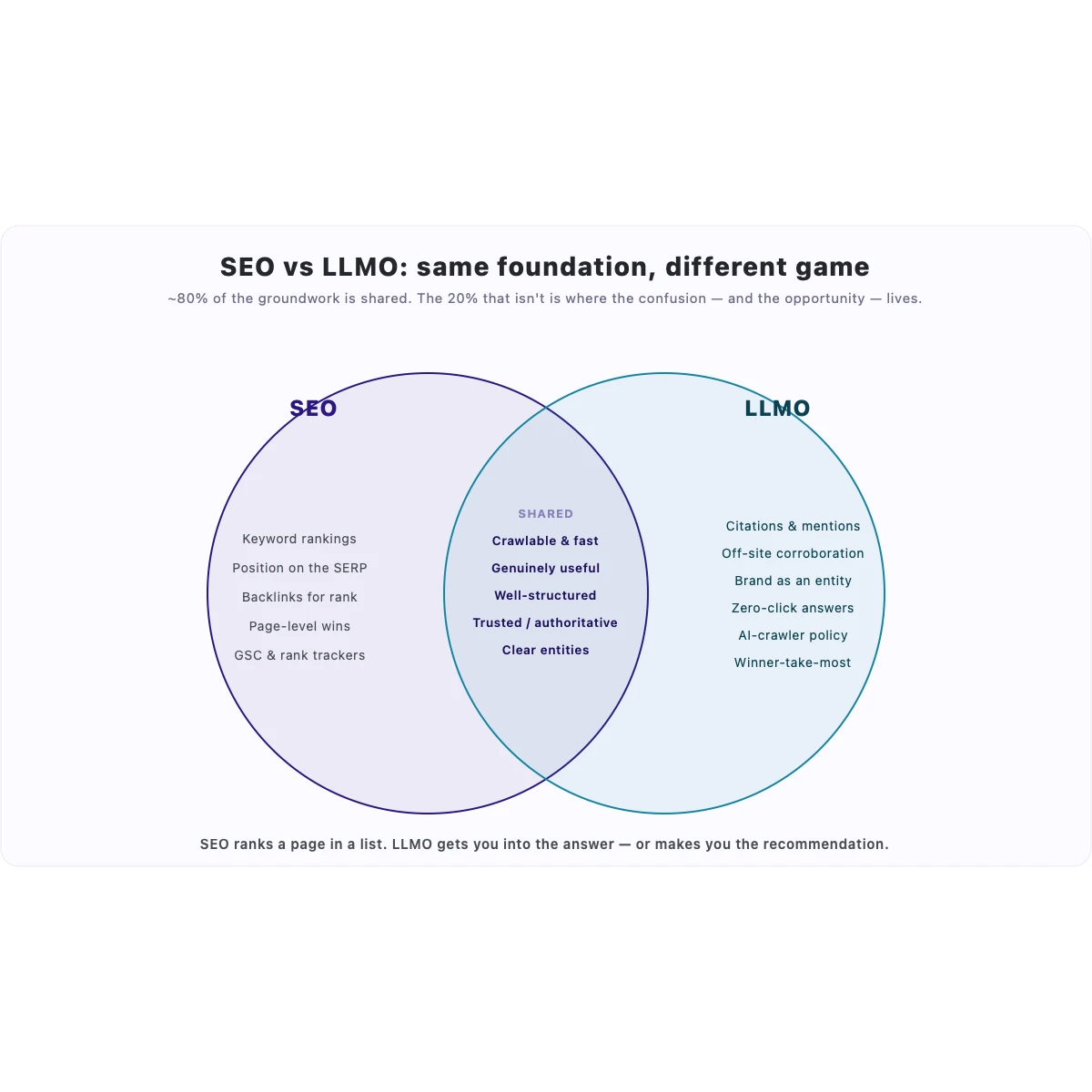
Every week someone asks us a version of the same question: “People are asking ChatGPT instead of Googling — is SEO dead, and should we be doing this new LLMO thing instead?”
The honest answer is more useful than the hype: it’s not either/or, and it’s not a replacement. The best way to hold it in your head is that the goal has shifted — from ranking a page to being the answer — and that shift keeps most of what you already do while adding a new layer on top.
Here’s exactly where the two overlap, where they genuinely diverge, and what to do about it.
The shared foundation — about 80% of the work
Start with the reassuring part, because it’s true: good SEO is a strong base for LLMO. Both a search engine and a language model are trying to find trustworthy, relevant, well-organised content and understand it. So both reward the same foundations:
- Crawlable and fast — content a bot can actually reach and read (not walled behind heavy JavaScript)
- Genuinely useful, expert content — Google’s E-E-A-T and “helpful content” push is, almost line for line, what makes a source worth citing
- Clear structure — headings, lists, tables, direct question-and-answer formatting (all of which make content extractable)
- Trust and authority — being referenced by others, corroborated, not thin or spammy
- Clear entities — schema markup, consistent naming, being unambiguously identifiable
Do this well and it serves both audiences at once. You do not throw SEO out to do LLMO — you build LLMO on it.
Where they diverge — the 20% that matters
The top of the stack is where the two genuinely part ways, and it’s where most of the confusion lives.
The clearest way to feel the difference: SEO fights for a position in a list; LLMO fights to be part of the answer.
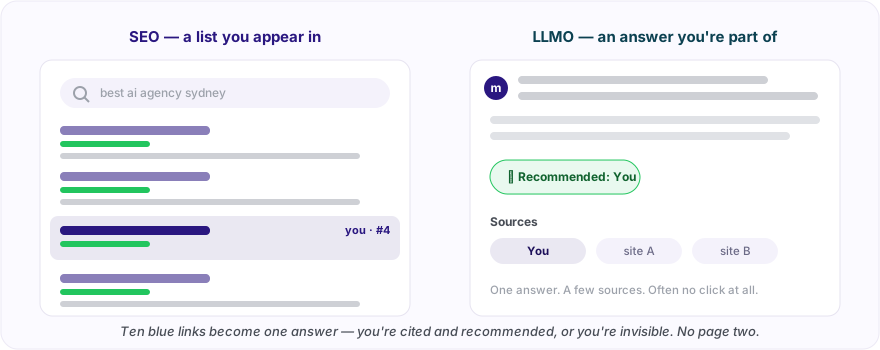
On the SERP there are ten blue links and a page two. In an AI answer there’s one synthesised response citing a handful of sources — and often a single recommendation. You’re either in it or you’re invisible. That changes almost everything downstream:
| Dimension | SEO | LLMO |
|---|---|---|
| Goal | Rank in a list of links | Be cited / recommended in a synthesised answer |
| Unit of success | A page ranking for a query | A claim or brand surfaced in an answer |
| Competitive shape | Ten blue links; fight for position | Often one answer, a few sources — winner-take-most, no page two |
| Intent | Keywords, usually short | Conversational, long, multi-part, with follow-ups |
| Biggest lever | Your pages plus backlinks | Off-site corroboration — being mentioned across sources the model trusts |
| Brand vs page | Can rank an unknown brand’s page | Models recommend brands they already know |
| Measurement | GSC, rank trackers, GA4 clicks | Opaque, non-deterministic, often zero-click — test the assistants; track mentions |
| Crawler policy | You always want Googlebot | A choice: allow AI crawlers, or stay invisible to that surface |
Three things most “GEO tips” miss
Plenty of “get cited by AI” advice is thin or already stale. Three points matter more than any tactic:
1. Zero-click is the point, not the problem. SEO has spent a decade mourning zero-click searches. In LLMO, the buyer often never visits your site — and that can be a win, because they arrive at the sales conversation already primed to recommend you. The metric shifts from traffic to presence in the decision. If the answer names you, the missing click is a feature.
2. It’s a compounding loop, not a separate channel. Getting genuinely cited and mentioned across the web produces exactly the authority and entity signals that also lift your traditional rankings. And the surfaces are converging — Google’s AI Overviews turn SEO content directly into AI answers. Do one well and you feed the other.
3. Don’t over-optimise for today’s model quirks. This is the big one, and it’s the same lesson as building anything else right now: half the clever “GEO hacks” being sold today will be obsolete in two model releases. The durable move isn’t gaming a current retrieval quirk — it’s being the genuinely best, most-trusted, most-mentioned answer to the questions your buyers actually ask. That happens to be what both Google and the models are converging on rewarding, and it’s the one strategy that survives the next release.
So what do you actually do?
Do the shared foundation once — it’s the prerequisite for everything: a fast, crawlable site; genuinely useful content written by people who know the subject; clean structure with schema and FAQs; and a clearly defined brand entity.
Then add the LLMO layer:
- Write answers, not just keyword pages. Lead with the direct answer, then support it. Structure content so a model can lift a clean, correct, quotable claim.
- Get corroborated off-site. This is the real work — digital PR, credible listicles, reviews, and presence in the communities models lean on. You influence LLMO as much by what others say about you as by what’s on your own site.
- Build the brand as a known entity. Consistent name, clear “who we are and what we do,” structured data — so the model recognises you and is comfortable recommending you.
- Decide your AI-crawler policy deliberately — allow the retrieval crawlers you want to be visible to, and use an
llms.txtto guide them to your best content. (We run one on this site.) - Measure differently. Ask the assistants your buyers’ questions and see who gets named. Track mentions and share-of-answer, not just rankings.
The honest bottom line
SEO isn’t dead and LLMO isn’t magic. They share a foundation — crawlable, useful, structured, trusted content — and diverge at the top, where SEO ranks a page and LLMO gets you into the answer. The businesses that win the next few years won’t pick one; they’ll do the shared foundation properly and then earn their place in the answer, without betting the strategy on this month’s model behaviour.
That’s exactly how we approach SEO and LLMO together — the durable foundation plus the AI-search layer — and how we build every site to be found, whichever way people are searching.
If this sparked something, let's talk.
No pitch, no pressure — just a conversation about what you're working on.
Let's talkRelated posts
AI Strategy
When Your Software Vendor Sells You AI: A Four-Question Test
Your ERP, CRM and accounting vendors are all adding AI tiers, because the per-seat model that built them is under threat. Before you buy, run four questions. Keep each vendor as your system of record, get the data out through its API, and use whichever AI is best this year.
AI Strategy
Inverting the Approval Pyramid: A Governance Model for Bottom-Up AI
Traditional organisations route every new initiative up to a few executives for approval. AI makes experiments nearly free, so that gate becomes the constraint. Here's an operating model: a sandbox anyone can use, a register, a promotion path, AI-prepared approval briefs, and a smaller, sharper role for the top.
AI Strategy
Did AI Just Kill BI? What to Stop Paying For, and Where to Spend Instead
Traditional business intelligence spent most of its budget on integration: ETL, data wrangling and merging systems. AI has collapsed that cost. Here's what leaders should stop funding, what deserves the money instead, and the questions to put to your BI vendor.