AI Strategy
Building for a Moving Target: Making Tech Decisions When the Models Keep Getting Better
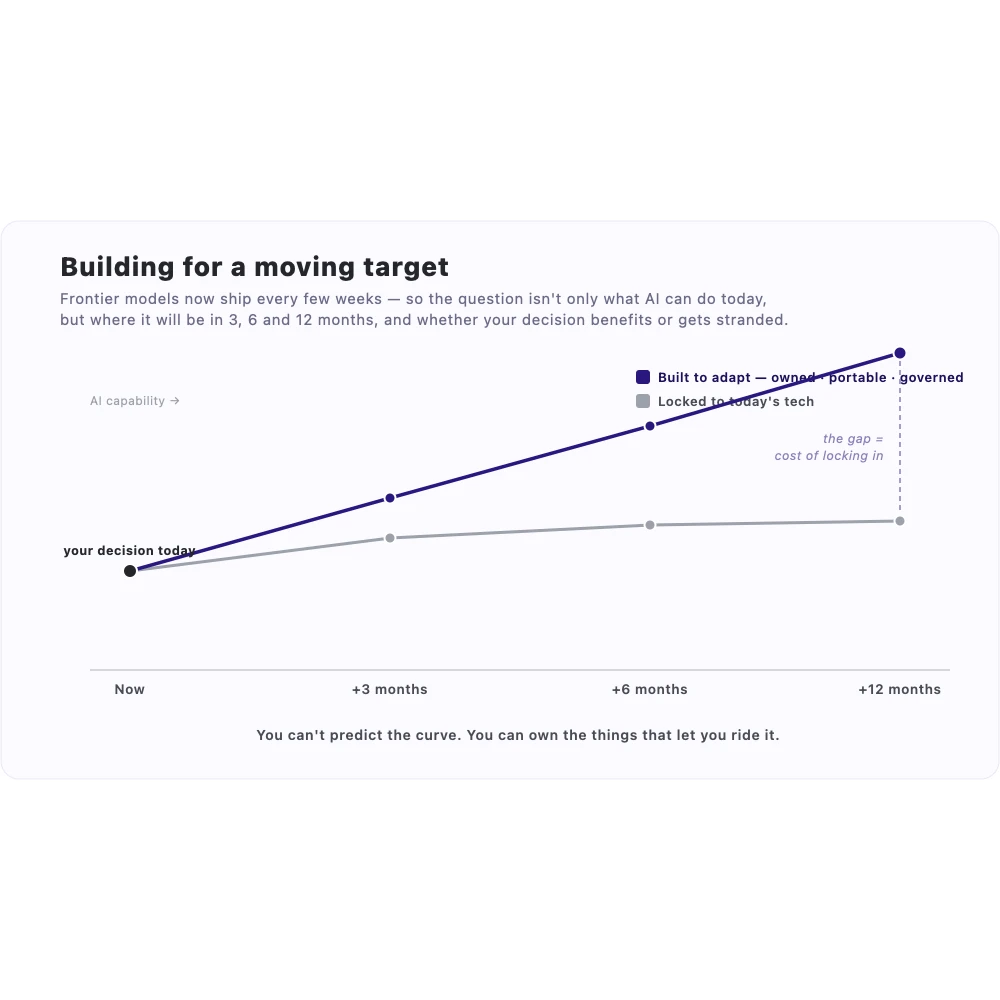
Here’s the uncomfortable truth about planning any technology project in 2026: whatever you decide today has to live in a world that will be meaningfully more capable in three months, and barely recognisable in twelve.
Frontier models used to arrive every year or two. Now a new one lands every few weeks — bigger context, sharper reasoning, more autonomy, lower cost. Things that were genuinely impossible last quarter are a checkbox this quarter. That’s exhilarating if you’re building, and paralysing if you’re deciding.
Because the question is no longer just “what can the technology do now?” If you’re weighing a website upgrade, an app project, or rebuilding your marketing stack, you have to ask the harder version: “where will this technology be in 3, 6, 12 months — and does the decision I’m making today benefit from that, or get stranded by it?”
The trap is building for today’s limits
There are two ways to get this wrong, and they sit at opposite ends.
The first is paralysis — waiting for the field to settle before you commit. It won’t settle. The cadence is speeding up, not slowing down, and every quarter you spend on the sidelines is capability, data and organisational muscle you don’t get back.
The second is subtler and more common: locking into today’s snapshot. You buy the proprietary platform that’s impressive right now. You let a SaaS hold your data because it’s convenient today. You have your team build clever workarounds for a model’s current limitation — and then the next release quietly erases that limitation, and your workaround becomes dead weight you now have to maintain.
Both mistakes hand the initiative to someone else. The way through is neither: move now, but on foundations that ride the wave instead of fighting it.
The future favours those who own the foundations
You can’t predict the capability curve. You can own the things that let you ride it whatever it does.
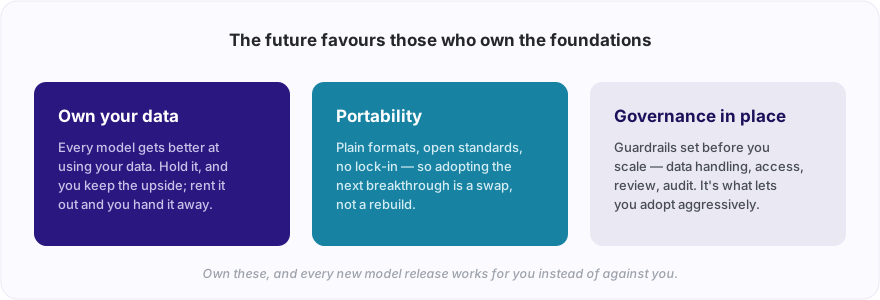
Own your data. This is becoming the whole game. Every model release gets better at turning data into value — so your proprietary data is a compounding asset, and whoever holds it captures the upside. Hold it yourself and every future model works for you specifically; rent it to a platform and you’ve handed that upside away, along with your freedom to take it somewhere better later.
Portability — no lock-in. Keep your assets in plain formats and open standards: text, code you own in Git, standard APIs. When the value lives with you rather than inside a vendor’s interface, adopting the next breakthrough is a swap, not a migration. This is also why we build model-agnostic marketing stacks — back the best model of the day, not a vendor’s bet from three years ago.
Governance in place. As capability and autonomy grow, so does the risk surface — data exposure, unreviewed automated decisions, access sprawl. The teams that adopt aggressively and safely are the ones who set the guardrails first: clear data handling, access control, human review, audit trails. Governance isn’t the brake; it’s what lets you floor it.
A few more bets that age well
Those three are the spine. A handful of others compound alongside them:
- Invest in capability, not tools. The specific tool is temporary; your team’s ability to direct AI is durable and compounds. The tools were never the point — the thinking was.
- Bias to reversible decisions. Move fast, but keep each choice cheap to change. Small, frequent feedback loops turn the rate of change from a threat into a tailwind — the faster you can adapt, the more every improvement helps you.
- Don’t over-engineer around today’s constraints. Half the ingenious workarounds people are building right now will be obsolete in two releases. Build the simple version; let the model catch up to it.
- Keep judgement in the loop. Models will keep automating the how. Deciding what’s worth doing, and whether the output is any good — taste, context, accountability — is the part that stays yours, and it’s where the leverage concentrates as everything else gets cheap.
- Instrument everything. If you can measure what’s working, you can evaluate each new model or tool objectively instead of on hype — and swap in what genuinely wins.
What this means for the decision in front of you
The three projects people ask us about most map straight onto this.
- A website upgrade? Build on owned, portable code — a framework you control on hosting you own — not a proprietary builder. Then you can rev the site as fast as the tools improve, and your rankings and content come with you. A builder locks you to its pace; owned code moves at yours.
- An app project? Own the data model and the code, and keep the architecture model-agnostic. The screens are cheap to regenerate as AI improves; the data and the structure are the expensive, durable part — so own those and stay loose on everything else. (It’s also the first thing we shore up when rescuing a stalled build.)
- Rebuilding your marketing stack? Own the repo, swap the model. Your prompts, brand voice, playbooks and content live with you; the model underneath is a commodity you upgrade whenever a better one ships.
The point
You will never time the curve perfectly — nobody will. But you don’t have to. You can be positioned so that whatever the next release brings, it lands as an upgrade you absorb rather than a wave that strands you.
The future doesn’t favour the fastest guess about where the technology is going. It favours whoever is best placed to benefit no matter where it goes — the ones who own their data, keep everything portable, and have governance in place. That’s not a prediction. It’s a posture, and it’s how we build — for ourselves and for our clients.
If you’re weighing one of those decisions, let’s talk about building it to last — which, these days, means building it to change.
If this sparked something, let's talk.
No pitch, no pressure — just a conversation about what you're working on.
Let's talkRelated posts
AI Strategy
When Your Software Vendor Sells You AI: A Four-Question Test
Your ERP, CRM and accounting vendors are all adding AI tiers, because the per-seat model that built them is under threat. Before you buy, run four questions. Keep each vendor as your system of record, get the data out through its API, and use whichever AI is best this year.
AI Strategy
Inverting the Approval Pyramid: A Governance Model for Bottom-Up AI
Traditional organisations route every new initiative up to a few executives for approval. AI makes experiments nearly free, so that gate becomes the constraint. Here's an operating model: a sandbox anyone can use, a register, a promotion path, AI-prepared approval briefs, and a smaller, sharper role for the top.
AI Strategy
Did AI Just Kill BI? What to Stop Paying For, and Where to Spend Instead
Traditional business intelligence spent most of its budget on integration: ETL, data wrangling and merging systems. AI has collapsed that cost. Here's what leaders should stop funding, what deserves the money instead, and the questions to put to your BI vendor.